Build Your Own Robot Fleet and Control It With Your Hands: The Vision Pro Robotics Revolution
How spatial computing, open-source hardware, and digital twins are creating a future where everyone manages robot armies
How spatial computing, open-source hardware, and digital twins are creating a future where everyone manages robot armies
The Future Is Gestural
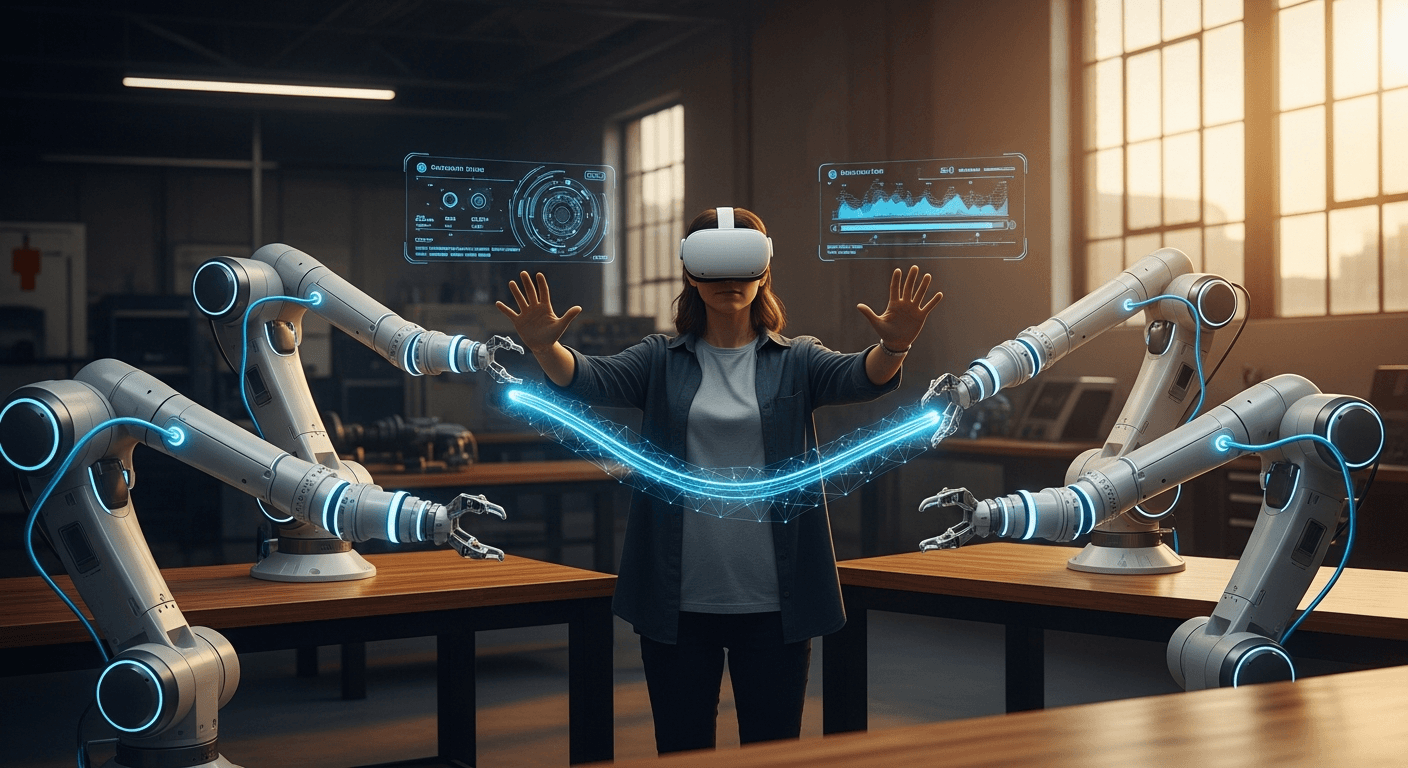
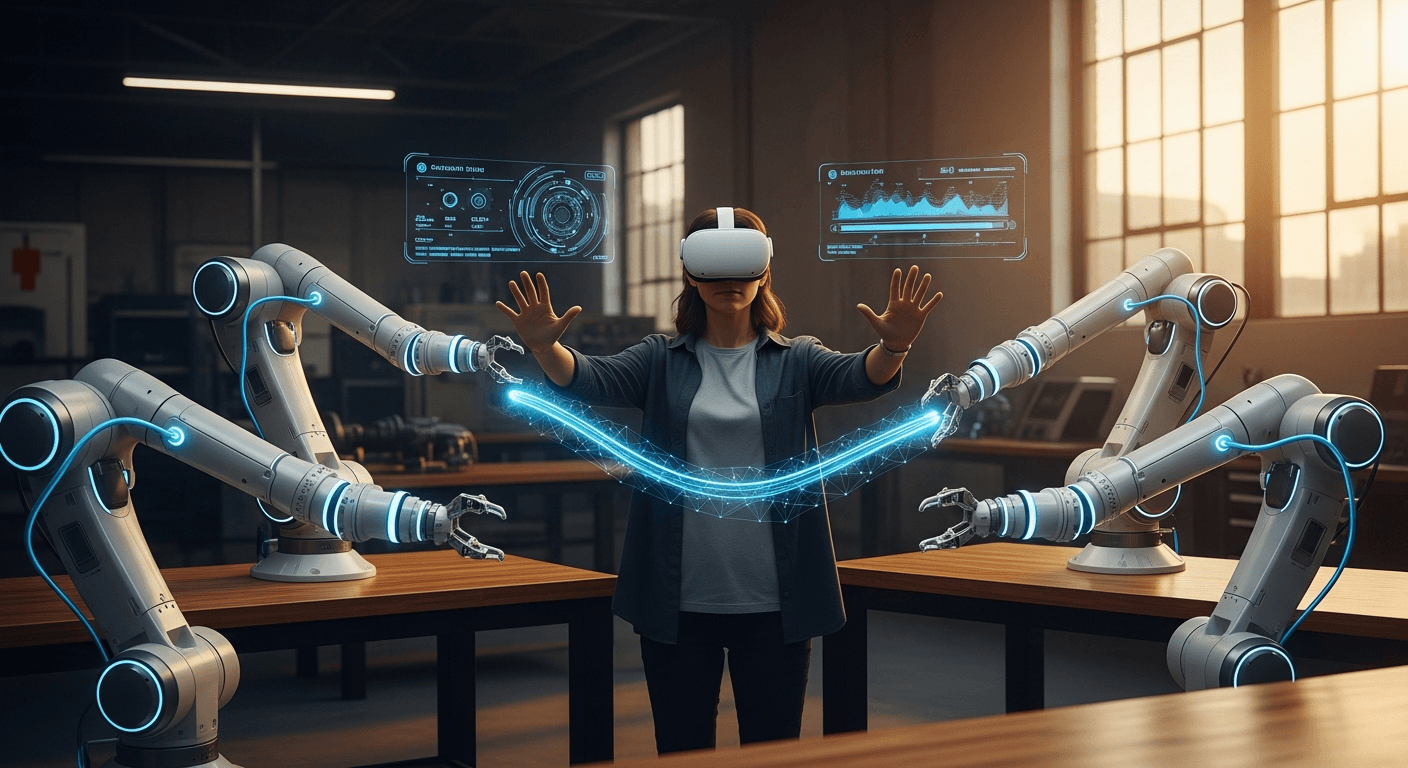
Imagine wearing a headset and seeing your robots floating in 3D space around you. You reach out, grab one with a pinch gesture, and it highlights. You move your hand—the robot arm mirrors perfectly. You voice command: "All robots, return to charging stations"—and they comply.
This isn't science fiction. It's possible today for under $6,000.
The convergence of Apple Vision Pro, sub-$500 open-source robot arms, and NVIDIA's digital twin simulation is creating something unprecedented: personal robot fleets controlled through spatial computing.
The Three Forces Converging
Force 1: Robots Got Cheap
Building your own robot arm used to cost tens of thousands. Now?
- Open6X: ~£400 total cost, 3D printable
- ARCTOS kits: Starting $231
- myCobot 280: $600-800 for a complete 6-axis arm
"Python dominates robotics kits because it's easy to learn, widely supported, and integrates with tools like OpenCV, TensorFlow, and ROS."
The software is equally accessible. ROS 2 (Robot Operating System) is free, with 50+ online courses available. NVIDIA Isaac Sim provides professional-grade simulation at no cost.
Force 2: Vision Pro Can Control Robots
MIT's Improbable-AI lab released VisionProTeleop—an open-source framework that connects Vision Pro directly to robot control:
- Hand tracking → robot motion
- Head gestures → camera control
- Voice commands → automation triggers
- Robot camera → Vision Pro display
"Stream your robot's camera feed to Vision Pro while receiving hand/head tracking data for control."
NVIDIA enhanced this at CES 2025, announcing Omniverse Spatial Streaming to Vision Pro—enabling industrial-scale digital twins rendered in your headset.
Force 3: Digital Twins Became Standard
Research shows 32% of XR robotics interfaces use digital twin visualization. Why? Because you can't effectively control robots you can't see.
Digital twins solve this by rendering robots and their environments as 3D spatial models. You preview actions in simulation before execution. You see what the robot sees. You understand the workspace without being physically present.
The Personal Robot Fleet Setup
Here's what a complete personal robot fleet costs today:
Hardware (3-Robot Fleet)
- 3x Open6X arms: ~$1,500
- Raspberry Pi controllers: $150
- Sensors/cameras: $300
- Mounting hardware: $200
- Subtotal: ~$2,150
Spatial Computing Interface
- Apple Vision Pro: $3,499
- Developer account: $99/year
- Subtotal: $3,598
Total: ~$5,750
For the price of a used car, you get a robot fleet you control by gesturing in 3D space.
The Massive Gap: Fleet Management
Here's the interesting part: 81% of XR robotics research focuses on single-robot scenarios. Multi-robot spatial interfaces barely exist.
Yet the IoT fleet management market is exploding—from $17.49B (2024) to $119.57B (2031). That's 6x growth.
Enterprise has digital twin dashboards for factory robots. Consumers have... nothing. The spatial computing app for managing personal robot fleets doesn't exist yet.
The opportunity is building it.
What the Vision Pro Robot Manager Looks Like
The Spatial Map: Your room renders with robot positions as digital twins. Reach out and interact with any robot in your space.
Data Halos: Sensor data orbits each robot as floating displays. Battery level, temperature, current task—all visible at a glance.
Gesture Commands: Point at robot, make a gesture, robot executes. No screens. No keyboards. Pure spatial interaction.
Voice Automation: "Show me all robots with battery below 20%"—low-battery units highlight. "Robot 2, repeat last task hourly"—scheduled.
Timeline Scrubbing: Grab a virtual slider, scrub backward, watch your fleet's history play back in 3D space.
Why 2026 Is the Moment
The International Federation of Robotics identifies 2026 as a transition year: "From passive automation to integrated, agentic autonomy."
Multiple convergences:
- 40M+ XR units projected by 2026 (IDC)
- $16.7B industrial robot market (all-time high)
- Tesla Optimus Gen 3 prototype in Q1 2026
- CES 2025 Vision Pro robotics announcements
The pieces are ready. The market is forming. The competition for prosumer spatial robot fleet management is essentially zero.
The Consumer Humanoid Reality Check
What about Tesla Optimus or Figure AI's Figure 03?
Tesla targets $20,000-30,000 at scale—but consumer availability is 2029+. Figure 03 estimates $30,000-150,000 with no consumer timeline.
"2026 is early adoption—reliability is questionable and prices are high. For most people, waiting until 2028-2030 makes financial sense."
The smarter play: build custom robot fleets now with proven, affordable technology. When humanoids mature, your spatial computing skills transfer directly.
Start Building Today
Step 1: Order an Open6X kit or ARCTOS arm ($231-500)
Step 2: Set up ROS 2 and Python environment (free, extensive tutorials)
Step 3: Simulate in Isaac Sim before physical deployment (free)
Step 4: If you have Vision Pro, deploy MIT's VisionProTeleop (open-source)
Step 5: Join the ROS community, share your fleet configurations
The technology exists. The price is accessible. The only barrier is starting.
The Future Is Fleet
Personal robotics isn't about one robot doing tasks. It's about fleets—multiple specialized robots working in coordination, managed through intuitive spatial interfaces.
Your home cleaning fleet: vacuum robot + mopping robot + arm for tidying. Your workshop fleet: multiple arms for different operations. Your garden fleet: mowing robot + planting arm + monitoring drones.
All visible in 3D. All controllable with gestures. All coordinated through voice commands.
This future is under $6,000 away. And it starts with building your first robot.
Sources
Written by
Global Builders Club
Global Builders Club
If you found this content valuable, consider donating with crypto.
Suggested Donation: $5-15
Donation Wallet:
0xEc8d88...6EBdF8Accepts:
Supported Chains:
Your support helps Global Builders Club continue creating valuable content and events for the community.