
Will Companies Exist in 2030? What the Data Actually Says
A viral prediction claims companies will cease to exist by 2030. We analyzed 12+ sources to see if the data supports this provocative thesis about AI, work transformation, and the post-employment future.
Will Companies Exist in 2030? What the Data Actually Says
A viral prediction meets economic reality
A provocative article went viral last week. Daniel Colin James, a crypto builder who previously contributed to George Gilder's "Life After Google," made a bold claim: by 2030, companies won't exist.
Not transformed. Not diminished. Gone.
The 4,000-word piece reads like science fiction written with the confidence of someone who's already seen the ending. Companies, James argues, were a 400-year experiment that peaked in the late 20th century. AI agents—tireless, autonomous, compounding—will replace traditional organizational structures. What remains won't be corporate hierarchies but "open, fair protocols" and, for most people, something simpler: gardens, fresh bread, and sunsets.
It's the kind of thesis that's easy to dismiss as techno-utopianism. But we spent a day digging through the data, and what we found was more nuanced—and more alarming—than expected.

The Corporation Was Already Dying
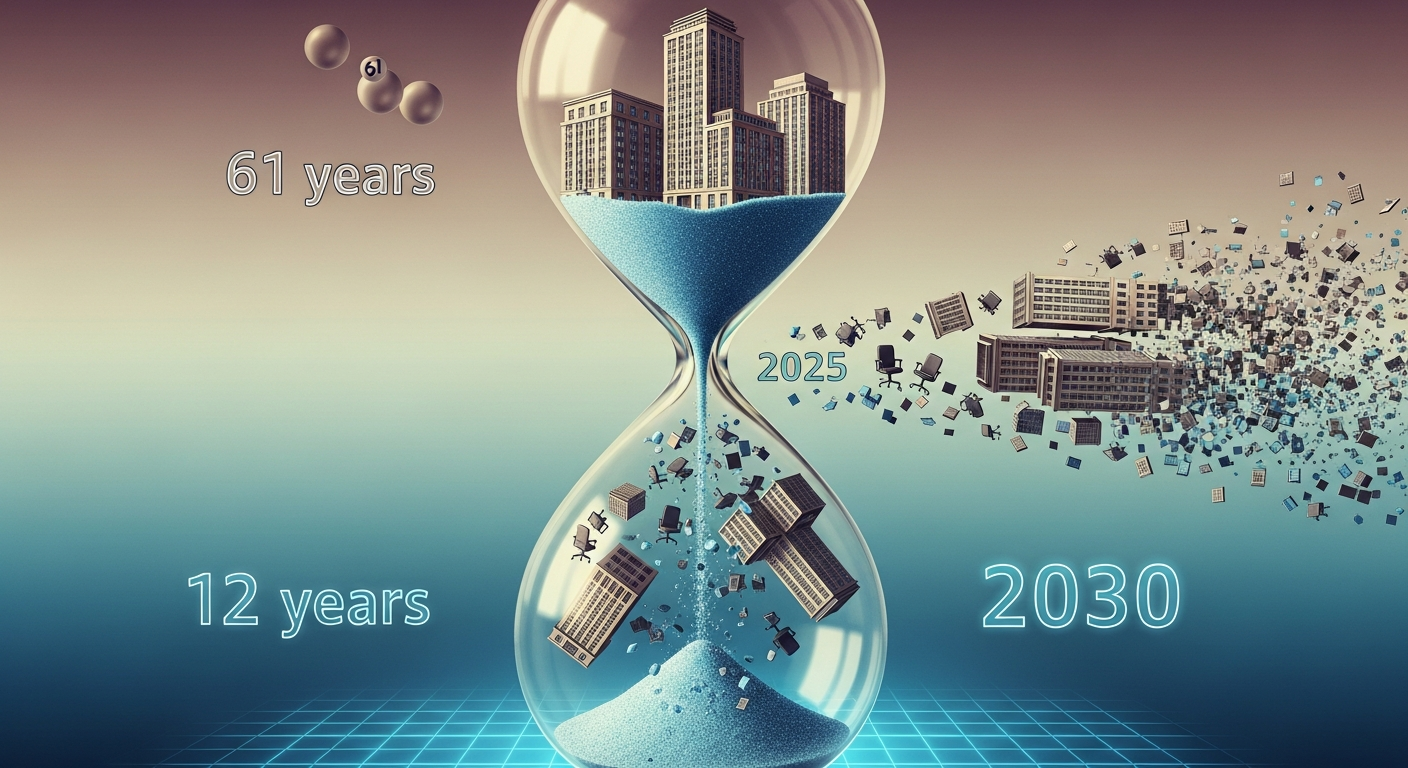
Here's a statistic that stopped us: In 1958, the average company on the S&P 500 lasted 61 years. Today, it's under 18 years. By 2027, projections suggest just 12 years.
McKinsey believes 75% of current S&P 500 companies will have disappeared by 2027—through acquisition, merger, or bankruptcy. Only 52 of the original 1955 Fortune 500 companies still exist in recognizable form.
This predates AI by decades. Companies now live shorter lives than individual careers. The traditional promise—give us 40 years, we'll give you a pension—is mathematically impossible when the employer won't exist in 20.
James didn't invent this crisis. He's just pointing out that AI will determine who inherits the vacuum.
The $9.6 Trillion Silent Scream
Gallup's latest global workplace data reveals something that should terrify every executive: only 21% of the world's workers are engaged at work. The rest are either coasting (54%) or actively disengaged.
The cost? $9.6 trillion annually. That's 9% of global GDP—lost productivity, lost innovation, lost human potential.
But here's what that number really means: four-fifths of humanity's workforce experiences employment as somewhere between neutral and actively harmful to their wellbeing. That's not a HR problem to be solved with better snacks and ping-pong tables. It's a legitimacy crisis for the entire corporate model.
When James writes that "billions of humans' worth of creativity and attention" were "rotting on the vine," he's not exaggerating. He's citing Gallup.
The Cavalry Isn't Coming
James's most devastating section describes how young people—the fresh blood that might have sustained traditional structures—arrived broken before they even started.
The data is stark:
- Gen Z reports 68% workplace stress—the highest of any generation ever measured
- 42% of teens report persistent feelings of sadness or hopelessness
- Teen depression has doubled since 2010
- Baby Boomers hold 52% of US wealth while comprising 20% of the population
- Millennials hold just 9.4% of wealth with roughly equal population share
- First-time homebuyer age has hit 40
- Tuition increased 1,200% while graduate underemployment reached 40%
"They had neither the tools nor the incentive to save the machine from itself," James writes. The statistics suggest he's right.

The 1000x Conductor
But the most fascinating part of James's thesis isn't about destruction—it's about creation.
"In the mid-2020s, software engineers briefly enjoyed unprecedented productive leverage," he writes. "The 10x engineer became the 1000x conductor and the rest of the world hardly noticed."
This is already happening:
- 37% of companies expect to replace jobs with AI by end of 2026
- 40% of enterprise applications will include autonomous AI agents by late 2026
- 79% of companies are already using agentic AI (PwC)
- GitHub's vision: 1 billion developers (up from millions)
Stanford economist Erik Brynjolfsson frames this elegantly: all work consists of asking questions, executing solutions, and evaluating results. AI has become exceptionally capable at execution—the middle phase. Human value is shifting entirely to the bookends: knowing what to build and knowing if it worked.
Brynjolfsson calls this the "Chief Question Officer" model. James calls it the 1000x conductor. Either way, the limiting factor on innovation—human bandwidth—is being removed.

The Cost Curves Are Merciless
Perhaps the most verifiable of James's claims is this: "What cost billions in 2020 cost pennies by 2030."
AI inference costs are falling faster than any technology in history. Research shows algorithmic efficiency improving roughly 3x per year. Marketing content that cost $20,000 to produce is now nearly free.
When creation costs collapse, incumbency means nothing. If credible alternatives can spawn, test, and distribute in days, established players lose their temporal advantage.
James writes that "moats worked until creation costs collapsed." The data suggests we're watching that collapse in real-time.

What Replaces Companies?
This is where James's thesis becomes most speculative—and most interesting. He envisions "gaps in society previously filled by companies and governments" being "better filled by open, fair protocols."
There's evidence for this:
- DAO participants grew from 13,000 to 1.7 million in 2021
- Wyoming recognized DAOs as legal entities
- Both Anthropic and Google donated their AI protocols to the Linux Foundation as open standards
But there's also evidence against it. Current DAOs suffer from token concentration, governance paralysis, and technical immaturity. The technology is ahead of the sociology.
And then there's James's most surprising answer to "what comes next":
"Gardens. Fresh bread. Sewing. Neighbors who knew your name. Slow meals. Bike rides with children. Sunsets from mountain tops."
Most people, he suggests, don't want to change the world. They just want a chance to experience it.
Our Assessment
Is James right that companies won't exist by 2030? Almost certainly not in the literal sense. But "unrecognizably transformed by 2030"? The data strongly supports this.
The convergence is real:
- Corporate lifespans collapsing
- Workforce engagement cratering
- Young people checking out
- AI capability exploding
- Costs plummeting
Something has to give.
The question isn't whether transformation happens. It's whether we design it for flourishing—or let it default to concentration. The "Turing Trap," as Brynjolfsson warns, is using AI to replace rather than augment humans, concentrating power among a few entities.
James is betting on humanity's "collective immune system"—the idea that attempts to hoard power will spawn open alternatives, that transparency will defeat exploitation, that most people will choose meaning over accumulation.
Maybe he's naive. Maybe he's prescient. Either way, the underlying trends he identifies are real, accelerating, and largely irreversible.
What This Means for Builders
At Global Builders Club, we think about these trends constantly. Here's what we believe:
1. Invest in judgment, not just execution skills. The ability to ask the right questions and evaluate AI outputs is becoming more valuable than the ability to execute.
2. Build portable identity. Your skills, reputation, and network need to exist independently of any single employer.
3. Develop AI fluency. This isn't optional—it's baseline survival.
4. Consider alternative paths. Traditional employment may not be the best vehicle for building wealth or meaning.
5. Design for flourishing. Whatever you build, ask: does this augment humans or replace them? Does this concentrate power or distribute it?
The Question You Should Be Asking
James ends his piece with a challenge: "Start thinking: what will you do with your extra 40 hours a week in the post-company world?"
Whether or not companies literally disappear, the nature of work is changing faster than most of us realize. The 10x engineer is becoming the 1000x conductor. The disengaged majority is looking for exits. The young people who might have sustained the old model are building something different.
The accountant who forgot he loved to dance? He remembered.
The entrepreneur who always wanted a boat? She sailed.
The editor who dreamed of writing children's stories? She wrote them.
What have you forgotten?
Sources
- Daniel Colin James (@dcwj) - "It's 2030. Companies don't exist"
- TechCrunch - Investors predict AI is coming for labor in 2026
- TIME - AI Changed Work Forever
- The Conversation - AI agents arrived in 2025
- Gallup - The World's $8.8 Trillion Workplace Problem
- Innosight - Corporate Longevity Forecast
- HR Dive - Companies will replace workers with AI by 2026
- McKinsey - AI: Work partnerships between people, agents, and robots
- World Economic Forum - Are DAOs the business structures of the future?
- Statista - U.S. wealth distribution by generation
Written by
Global Builders Club
Global Builders Club
If you found this content valuable, consider donating with crypto.
Suggested Donation: $5-15
Donation Wallet:
0xEc8d88...6EBdF8Accepts:
Supported Chains:
Your support helps Global Builders Club continue creating valuable content and events for the community.