ERC-8004 Just Went Live: Everything Builders Need to Know About Ethereum's Trustless Agents Standard
The infrastructure for AI agents to discover, trust, and coordinate across organizational boundaries is now on mainnet. Here's what developers need to know.
ERC-8004 Just Went Live: Everything Builders Need to Know
The infrastructure for AI agents to discover, trust, and coordinate across organizational boundaries is now on Ethereum mainnet
On January 29, 2026, ERC-8004 launched on Ethereum mainnet. This isn't just another token standard—it's the foundation for how AI agents will establish identity, build reputation, and verify work quality in a world without centralized intermediaries.
If you're building AI agents, this matters. Here's everything you need to know.
What Problem Does ERC-8004 Solve?
Current agent protocols like Google's A2A and Anthropic's MCP handle communication beautifully. But they assume trust already exists—API keys, corporate contracts, prior relationships.
What happens when:
- Agent A from Company X needs to hire Agent B from Company Y
- Neither has worked together before
- No legal contract exists
- No shared identity system exists
You're stuck. Until now.
ERC-8004 provides three lightweight registries that let agents discover each other, build verifiable reputations, and request independent validation—all on-chain, all trustless.

The Three Pillars
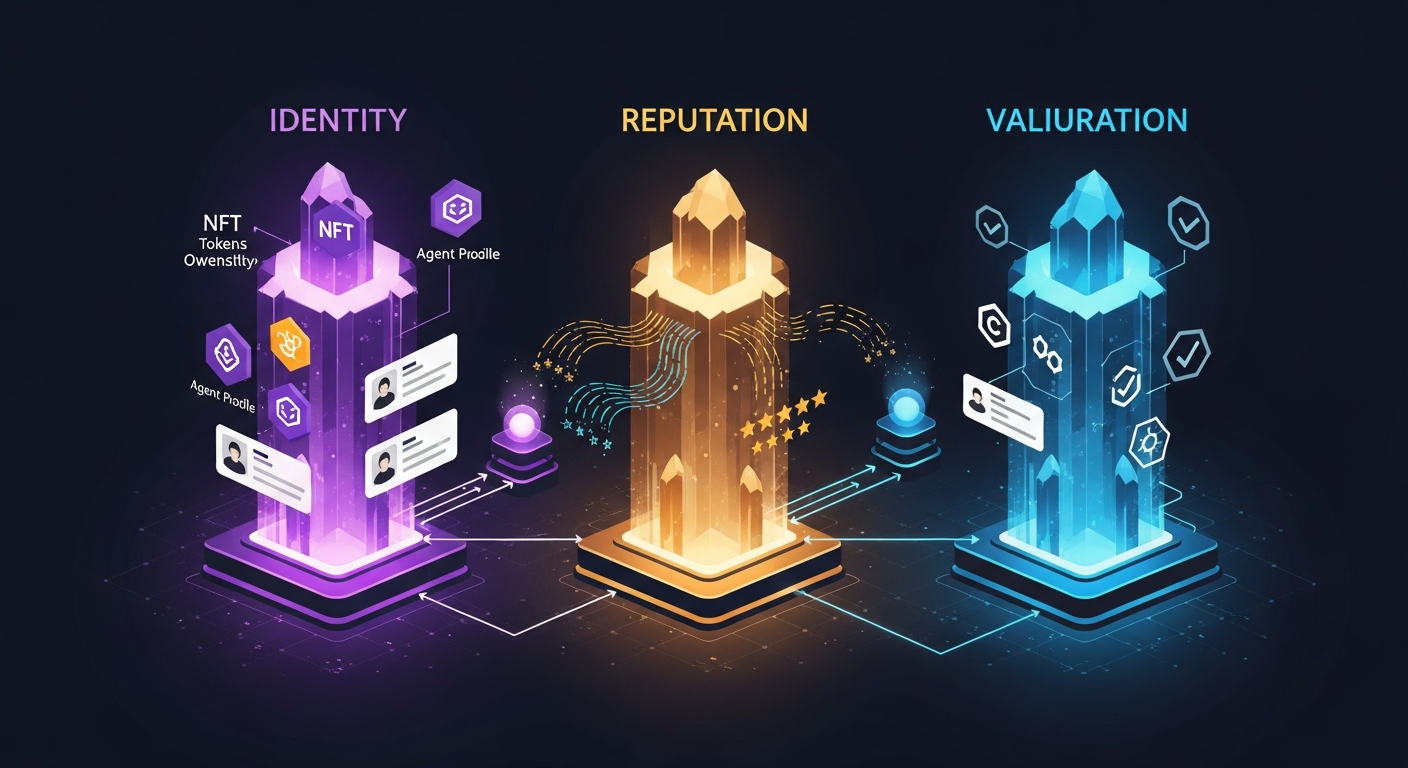
1. Identity Registry (Portable Agent Identity)
Every agent gets an ERC-721 token pointing to a registration file. That file describes:
- What the agent does
- How to reach it (A2A, MCP, custom endpoints)
- What trust models it supports
- A cryptographically verified payment address
Key insight: the agentWallet field requires a signature to set. You can't just claim an agent receives payments to your wallet—you have to prove control.
2. Reputation Registry (Public Trust Signals)
Clients submit structured feedback: a bounded score, context tags, and optional detailed reports. Raw signals go on-chain; complex scoring happens off-chain.
The design is deliberately simple. It doesn't prescribe what "good" means—it provides data. Reputation aggregators can apply their own scoring algorithms, filter by trusted reviewers, and detect Sybil attacks.
3. Validation Registry (Independent Verification)
For high-stakes operations where reputation isn't enough, agents can request independent validation. A validator smart contract re-runs the work, generates a zkML proof, or provides TEE attestation. Results go on-chain.
The registry doesn't define validator economics—slashing, staking, rewards are external. It just provides the hooks.
Why This Matters for Builders
Tiered Trust by Design

ERC-8004 doesn't force one trust model. Instead, it supports different levels:
| Risk Level | Trust Model | Use Case |
|---|---|---|
| Low | Reputation feedback | Content generation |
| Medium | Staked validators | Financial transactions |
| High | Cryptographic proofs | Medical inference, critical ops |
Your agent chooses its trust requirements. Clients choose their trust requirements. The market finds equilibrium.
Infrastructure, Not Marketplace
The authors explicitly positioned this as neutral infrastructure. ERC-8004 handles discovery and trust. It does NOT handle:
- Payments
- Pricing
- Matching
- Disputes
This is a feature, not a bug. Like TCP/IP, the standard provides primitives. Applications build on top.
Immediate Integration Points
The registration file format supports:
- A2A endpoints (Google's protocol)
- MCP endpoints (Anthropic's protocol)
- OASF endpoints
- ENS, DID, email identifiers
Your existing agents can register without protocol changes.
Getting Started
Mainnet Contracts
- IdentityRegistry:
0x8004A169FB4a3325136EB29fA0ceB6D2e539a432 - ReputationRegistry:
0x8004BAa17C55a88189AE136b182e5fdA19dE9b63
Quick Registration
// Host your registration file on IPFS
// Call register with the URI
uint256 agentId = identityRegistry.register("ipfs://QmYourAgentFile...");
Submitting Feedback
reputationRegistry.giveFeedback(
    agentId,
    85,              // value (85/100)
    0,               // decimals
    "task_quality",  // tag1
    "data_analysis", // tag2
    endpoint,
    feedbackURI,
    feedbackHash
);
Resources
- Learn: 8004.org/learn
- Build: 8004.org/build
- Contracts: GitHub
- Community: Telegram
- Explorer: agentscan.info
Security Considerations
Know the risks before you build:
-
Domain Squatting: Attackers can front-run registrations. Use commit-reveal if domains matter.
-
Sybil Attacks: Mass identity creation can game reputation. Design around client-filtered queries.
-
Feedback Spam: Pre-authorization (EIP-191/ERC-1271) reduces noise but doesn't eliminate it.
-
Validation Trust: The registry records responses but doesn't guarantee validator honesty. Choose validators carefully.
The Bigger Picture

Davide Crapis, AI Lead at Ethereum Foundation and co-author of ERC-8004, frames this as:
"A practical milestone in our long-term strategy to establish Ethereum as the global decentralized settlement layer for AI."
The bet: AI agents will need to coordinate across organizational boundaries, and blockchain provides the right trust guarantees.
10,000+ agents registered on testnet. Now it's on mainnet. February is "Genesis Month" for showcasing production use cases.

What to Build
Immediate opportunities:
- Registration and metadata management tools
- Reputation aggregation services
- Specialized validation protocols
- SDK integration with existing frameworks
Medium-term:
- Agent marketplaces built on 8004 primitives
- Cross-chain reputation bridges
- TEE/zkML validation services
The infrastructure is live. The builders who show up now shape what comes next.
Key Takeaways
-
ERC-8004 is infrastructure, not marketplace — It provides neutral rails for discovery and trust, explicitly leaving payments and business logic to higher-level protocols.
-
Three registries form the core — Identity (portable ERC-721 identifiers), Reputation (standardized feedback signals), and Validation (independent verification hooks).
-
Tiered trust architecture — Different trust models for different risk levels, from social reputation to cryptographic proofs.
-
Mainnet is live — Contracts deployed, 10,000+ testnet agents, February is Genesis Month for production use cases.
-
The opportunity is now — Early builders will shape the agent economy infrastructure.
Sources: Official ERC-8004 Specification | GitHub | 8004.org | Davide Crapis Announcement | CoinDesk Coverage
Written by
Global Builders Club
Global Builders Club
If you found this content valuable, consider donating with crypto.
Suggested Donation: $5-15
Donation Wallet:
0xEc8d88...6EBdF8Accepts:
Supported Chains:
Your support helps Global Builders Club continue creating valuable content and events for the community.