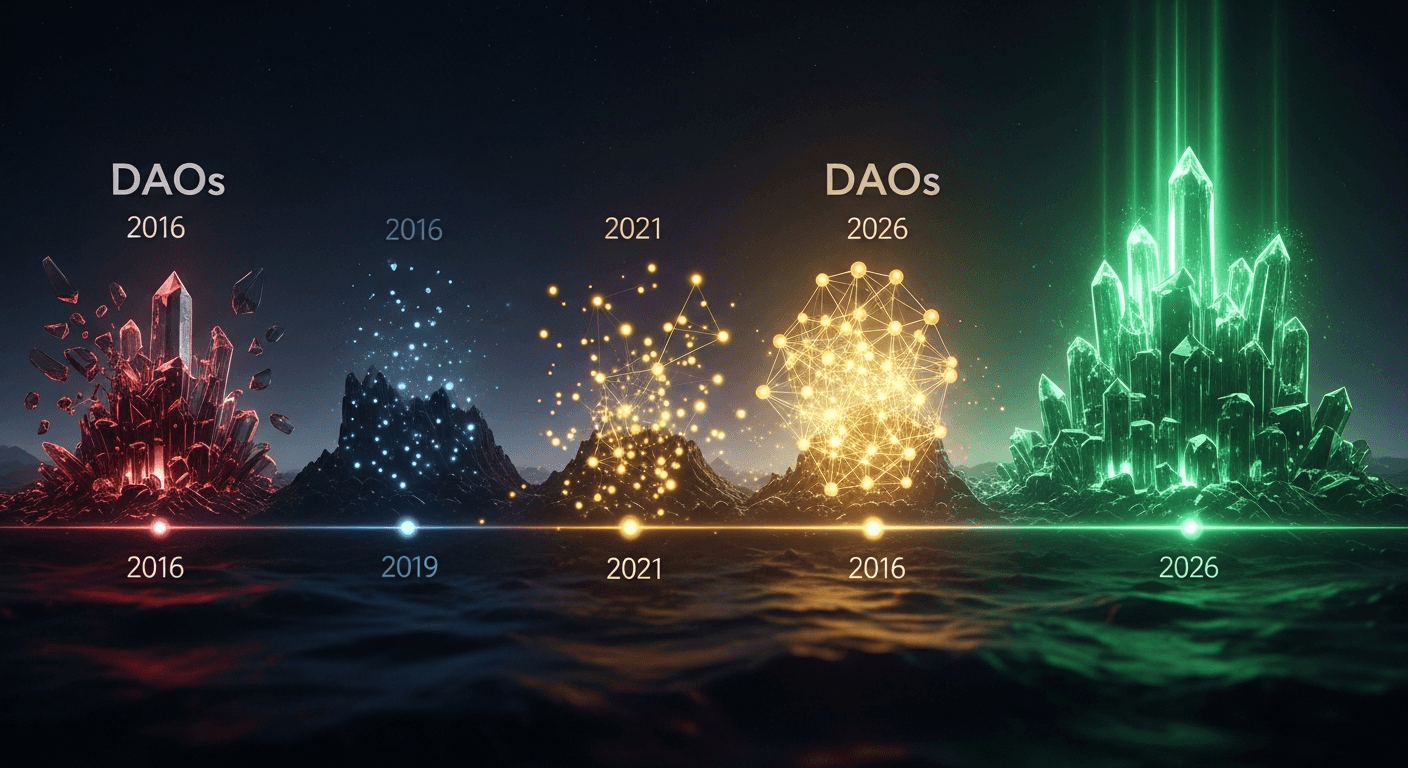
The Complete History of DAOs: From $150M Disaster to $40B Ecosystem
How a 2016 hack that nearly killed Ethereum became a $220 million security fund—and what 13,000 DAOs have built in between.
How a 2016 hack that nearly killed Ethereum became a $220 million security fund—and what 13,000 DAOs have built in between.
In June 2016, someone exploited a smart contract bug and drained $50 million from The DAO. Ethereum hard forked. The crypto world declared decentralized governance dead.
Ten years later, The DAO is back—with $220 million and Vitalik Buterin as curator.
Between those bookends lies the most unexpected organizational experiment in human history: 13,000+ DAOs holding $40 billion, governing everything from DeFi protocols to art collections to attempts to buy the U.S. Constitution.
Here's the complete timeline.
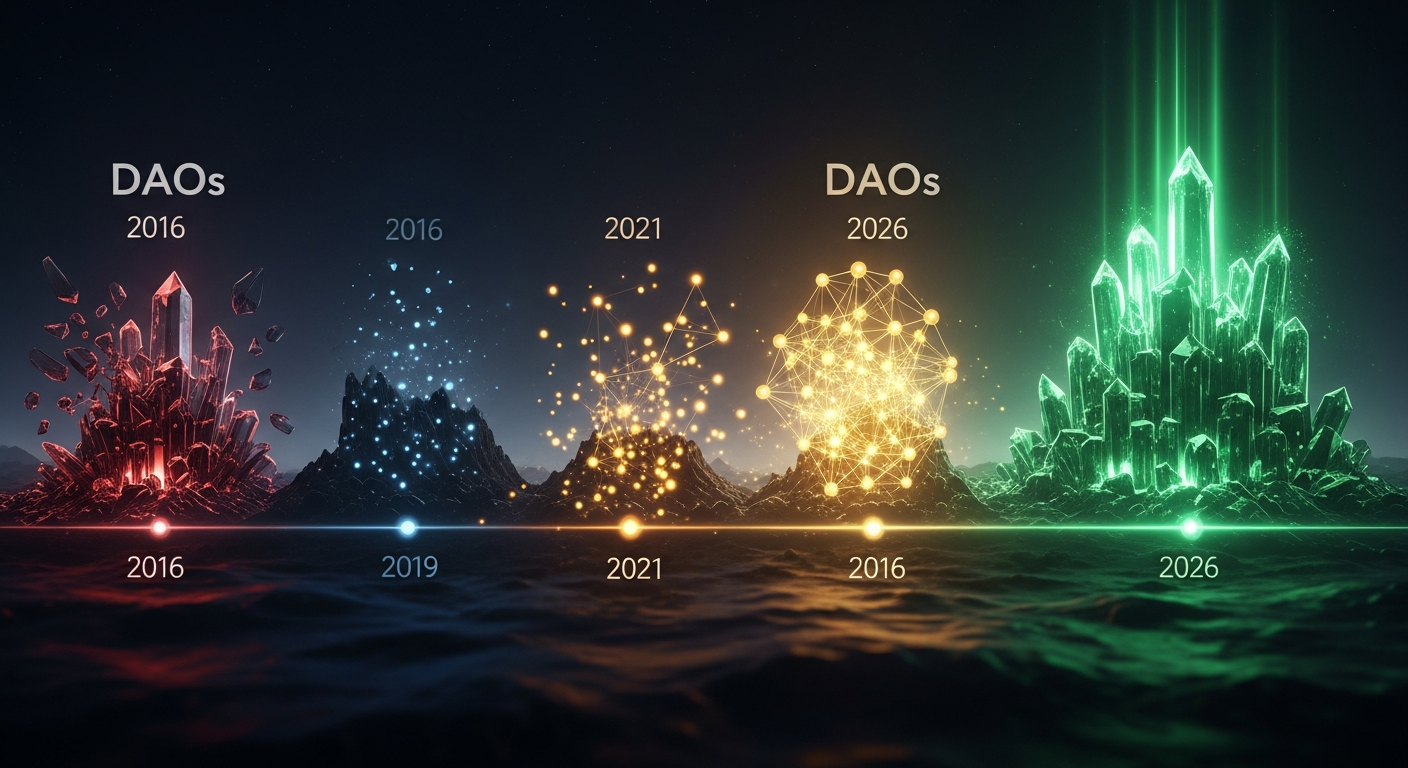
The Pre-History (1990s-2015)
The term "decentralized autonomous organization" wasn't invented for crypto. It emerged in the 1990s to describe multi-agent IoT systems—networks of devices coordinating without central control.
Crypto adopted the concept in 2013-2014. Forum discussions about "Decentralized Autonomous Companies" imagined tokenized shareholder governance. In 2014, Vitalik Buterin called DAOs "the holy grail" of blockchain applications.
By 2015, Rune Christensen was sharing plans for "eDollar"—what would become DAI and MakerDAO. The pieces were falling into place.
2016: The Trauma
April 30: The DAO launched with a 28-day crowdsale.
May 21: $150 million raised from 11,000+ investors. The largest crowdfund in history. The DAO held 14% of all Ethereum in existence.
June 17: Everything collapsed.
An attacker found a reentrancy vulnerability—a bug that let them withdraw funds repeatedly before the contract updated balances. In hours, 3.6 million ETH (~$50 million) was gone.
The Ethereum community faced a brutal choice: let the theft stand (preserving blockchain immutability) or hard fork to restore funds (breaking the "code is law" principle).
They chose the fork. Ethereum split. The original chain became Ethereum Classic. And DAOs became a cautionary tale.

2017-2018: The Quiet Building
The hack cast a long shadow, but builders kept building:
Late 2016: Luis Cuende and Jorge Izquierdo founded Aragon—the first comprehensive DAO framework.
December 2017: MakerDAO went live, pioneering decentralized stablecoin governance.
November 2018: Uniswap launched (later becoming DAO-governed).
These weren't headline projects. The market was obsessed with ICOs. But the infrastructure for DAO 2.0 was being laid.
2019: The Recovery
ETHDenver, February 2019: Ameen Soleimani and Cassandra Shi unveiled MolochDAO with a critical innovation: rage quitting.
For the first time, members could exit with their proportional share of funds if they disagreed with the majority. Minority protection, built into code.
MolochDAO was small—funding Ethereum 2.0 development—but its model spawned a new generation: MetaCartel, DAOhaus, RaidGuild.
The DAO concept was alive again.
2020-2021: The Explosion
NFT DAOs Emerged
As NFT prices soared (CryptoPunks hit $380,000 floor), collector DAOs formed to pool capital:
- PleasrDAO bought Edward Snowden's first NFT for 2,224 ETH
- FlamingoDAO acquired an Alien CryptoPunk for 605 ETH
- Nouns launched August 2021 with perpetual daily auctions and CC0 licensing
ConstitutionDAO Changed Everything
November 2021: A group tried to buy an original U.S. Constitution at Sotheby's.
The numbers were staggering:
- 17,000 contributors
- $47 million raised
- 72 hours
They lost to billionaire Ken Griffin. But they proved something more important: mass coordination at scale is possible.
Legal Recognition Arrived
July 1, 2021: Wyoming became the first U.S. state to recognize DAOs as legal entities.
The Numbers Exploded
- NFT sales: $94.8M (2020) → $13B (2021)
- New DAOs launched weekly
- Gnosis Safe made multi-signature treasury management accessible
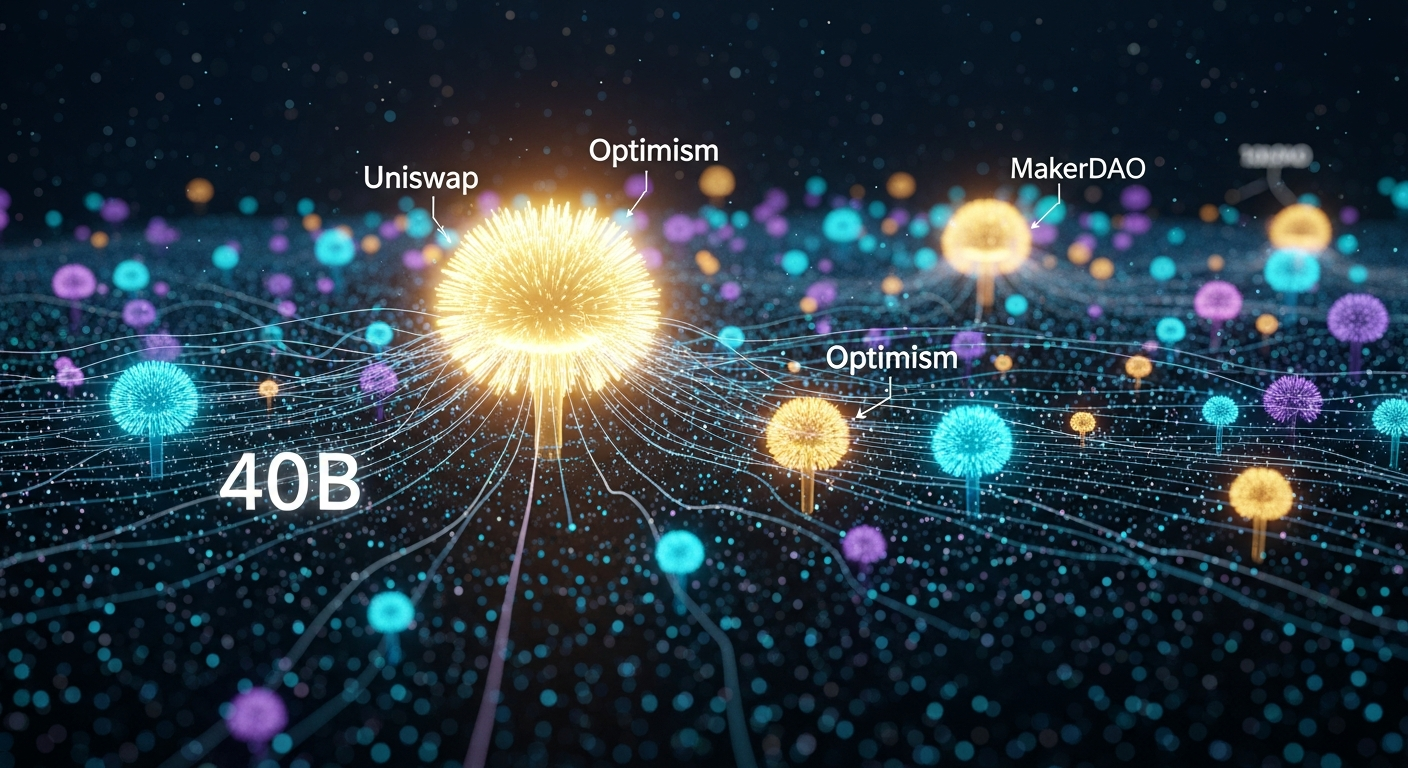
2022-2024: Growing Pains
Governance Attacks
2022: One person accumulated enough tokens to take over Build Finance DAO, then drained it.
2024: Attackers quietly accumulated 228,000 COMP tokens—80% of Compound's quorum threshold. The attack was caught, but barely.
The Concentration Problem
Studies confirmed what critics suspected:
- <0.1% of holders often control 90% of voting power
- 17% average voter participation
- 85% of DAOs hold treasury in single asset (usually their own token)
DAOs designed to distribute power were concentrating it.

Legal Progress
July 2024: Wyoming's DUNA Act created better nonprofit DAO structures. Andreessen Horowitz called the state an "oasis" and committed to bringing DAOs there.
2026: Full Circle
January 29, 2026: Ethereum OGs announced The DAO's return.
Over 75,000 ETH (~$220 million) from unclaimed original funds became a Security Fund. Vitalik Buterin joined as curator.
The fund will:
- Issue ecosystem grants
- Generate staking yields (~$8M/year)
- Support audits, wallet safety, protocol upgrades, developer tools
Ten years after nearly destroying Ethereum, The DAO is funding its security.
The Framework Landscape
Who Dominates What
| Platform | Specialty | Market Position |
|---|---|---|
| Snapshot | Gasless voting | 96% market share |
| Aragon | Full DAO suite | 3x more active than DAOhaus |
| DAOhaus | No-code Moloch | Grant allocation leader |
| Colony | Task-driven teams | Unique reputation model |
The Snapshot problem: when 96% of DAO voting runs through one platform, how decentralized is governance?
The Most Successful DAOs
By Treasury
- Uniswap - Largest treasury overall
- Optimism - $3.1 billion, bicameral governance
- MakerDAO/Sky - Pioneer, DAI/USDS governance
- Arbitrum - Most active Ethereum DAO
- Lido - 39.7K ETH
By Innovation
- MolochDAO - Invented rage quitting
- Nouns - Perpetual funding + CC0 + first DAO-funded movie
- Gitcoin - Quadratic funding for public goods
- ConstitutionDAO - Proved mass coordination
How DAOs Are Actually Used
DeFi Governance: Uniswap, Compound, Aave, MakerDAO—token holders vote on protocol parameters.
Investment Clubs: Orange DAO (YC alumni), BitDAO (Peter Thiel-backed)—pooled capital with legal wrappers.
NFT Collecting: PleasrDAO, FlamingoDAO, Nouns—collective ownership of digital art.
Public Goods: Gitcoin distributes millions quarterly via quadratic funding.
Social Communities: Friends With Benefits—token-gated networking and events.
Crowdfunding: ConstitutionDAO's $47M in 72 hours proved the model.
The Uncomfortable Truth
The Promise
DAOs would replace hierarchies with code-based democracy.
The Reality
- 85% of treasuries undiversified
- <0.1% often control 90% of votes
- 17% voter participation
- Multiple governance attacks in 2022-2024
Governance is harder than code.

What Comes Next
2026-2027:
- The DAO Security Fund distributes first grants
- DUNA adoption accelerates
- More L2 DAOs follow Optimism/Arbitrum
2027-2028:
- Quadratic voting becomes standard
- Sub-DAO structures mature
- Legal frameworks expand globally
Long-term:
- AI agents as DAO participants
- Cross-border DAO treaties
- Reputation overtakes token-weighted voting
The Bottom Line
DAOs have traveled from theoretical concept to $40 billion ecosystem in a decade. The DAO's 2016 hack nearly killed the idea. Its 2026 revival proves the concept's resilience.
But the fundamental challenge remains: how do you achieve decentralized governance when tokens concentrate and voters disengage?
The next chapter will be written by those who solve this paradox—not through more tokens, but through better mechanisms for participation and accountability.
The infrastructure exists. The capital exists. The legal frameworks are emerging.
What's missing is the governance design that actually distributes power.
Sources: Aragon History of DAOs | CoinLaw Treasury Statistics | Tapbit DAO Revival
Written by
Global Builders Club
Global Builders Club
If you found this content valuable, consider donating with crypto.
Suggested Donation: $5-15
Donation Wallet:
0xEc8d88...6EBdF8Accepts:
Supported Chains:
Your support helps Global Builders Club continue creating valuable content and events for the community.