The Peer Education Revolution: How Crypto Rails, Token Incentives, and Soulbound Credentials Are Rebuilding Learning
The $400B e-learning market has a 5% completion problem. Here's how peer-led learning, token economics, and soulbound credentials fix it.
The Peer Education Revolution: How Crypto Rails, Token Incentives, and Soulbound Credentials Are Rebuilding Learning From Scratch
The $400B e-learning market has a 5% completion problem. Here's how to fix it.
The Dirty Secret of Online Education
Coursera and Udemy just merged in a $2.5 billion deal. Combined, they'll serve 191 million learners and generate $1.5 billion annually.
Impressive numbers. But beneath the scale lies a fundamental problem they've never solved: 5% completion rates.
Ninety-five percent of people who enroll in online courses never finish them.
That's not education. That's expensive content marketing disguised as learning.

The 42 School Proof Point
Meanwhile, in Paris, a network of coding schools with zero professors achieves 100% graduate employment.
42 School, founded in 2013, operates on a radical premise: students teach students.
- No professors - Peer-to-peer learning only
- No tuition - Completely free
- Open 24/7 - Self-paced, project-based
- 50+ campuses - 30+ countries
- 50% never coded before joining
The results? 100% employment. 80% have job offers before graduation. 30% build their own companies.
When students teach each other, learning is deeper. Teaching requires understanding. Explaining solidifies knowledge. Peer evaluation catches gaps instructors miss.
70% vs. 5%: The Completion Revolution
42 School proves peer teaching works in person. But does it scale digitally?
Evita DAO, a Web3 education community, runs "masterminds" where students teach each other online. Their completion rate: 70%.
That's 14x better than the MOOC industry average.
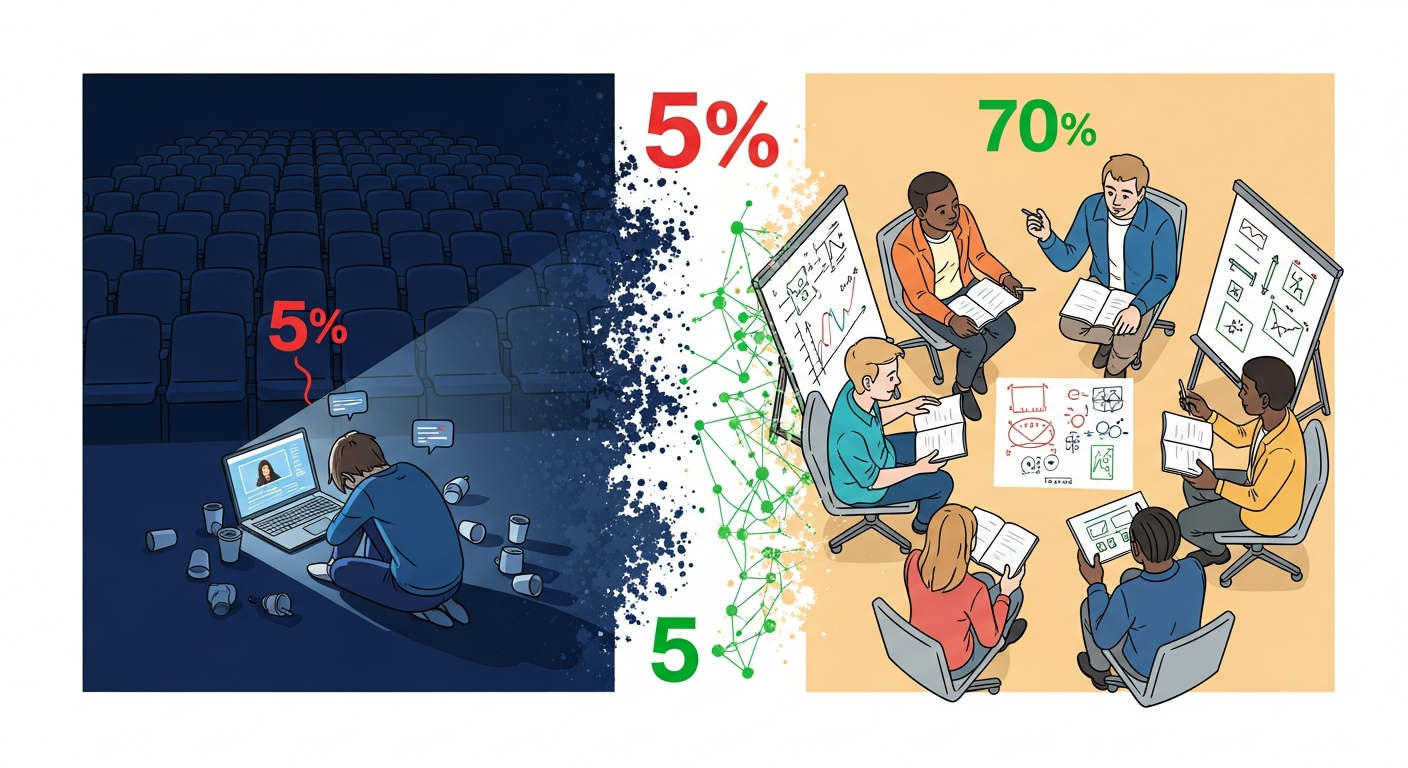
The mechanism isn't complex:
- Small peer pods with mutual accountability
- Requirement to explain concepts to others
- Real stakes through token incentives
- Community over isolation
Learn-to-Earn: Token Economics for Education
Blockchain education platforms report 40% increase in completion rates when learners earn tokens for progress.
DirectEd Development, operating in Kenya and Ethiopia, ties scholarship disbursement to milestone tokens earned through exams. Pass your monthly test, receive tokens redeemable for funding. This flips the aid model: money flows to achievement, not just enrollment.
Beyond completion incentives, governance tokens create stakeholder alignment. Education DAOs let learners vote on:
- Course topics and priorities
- Resource allocation
- Guest speakers and mentors
- Quality standards
Students transform from passive consumers to active governors of their own education.
Soulbound Tokens: Credentials That Can't Be Faked
Anyone can claim a Harvard degree on LinkedIn. Employers spend billions annually on background verification. The credential system is fundamentally broken.
Ethereum founder Vitalik Buterin proposed a solution in his 2022 paper "Decentralized Society: Finding Web3's Soul": Soulbound Tokens (SBTs).

SBTs are non-transferable NFTs permanently bound to your wallet:
- Can't be bought or sold - No credential markets
- Instantly verifiable - Check on-chain, no phone calls
- Fraud-proof - Harvard's wallet must issue to your wallet
- Revocable - Issuer can burn if credential is invalidated
"Anyone can say they went to Harvard by marking it on Facebook. But with SBTs, Harvard's Soul would have to grant your Soul an SBT diploma for you to effectively make that claim."
NIST data shows blockchain credential implementations reduce fraud by 40%.
Stablecoin Rails: Education Without Borders
The global average cost to send money internationally remains above 6%. For a student in Kenya trying to pay tuition to a platform in the US, traditional banking is:
- Expensive (high fees)
- Slow (days for settlement)
- Exclusive (requires bank account)
- Limited (business hours only)
Stablecoin payments change everything:
- 35% cost reduction vs. traditional rails
- Near-instant settlement (minutes, not days)
- 24/7 operation (no bank hours)
- No bank account required (phone wallet sufficient)
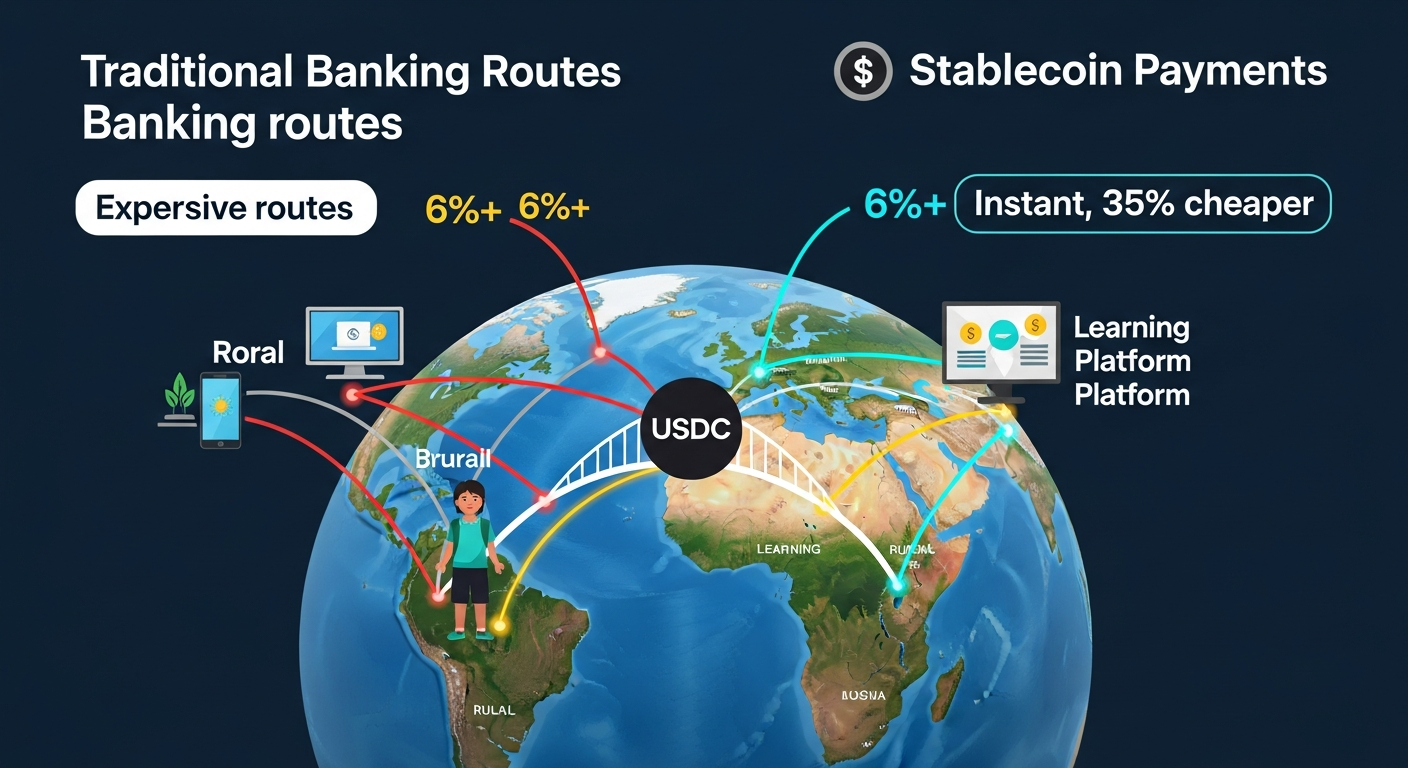
Circle's Payments Network, launching in 2025, aims to rival Visa and Mastercard for global transfers. Their assessment: "Stablecoins have reached adoption level to disrupt global money transfers similar to WhatsApp and international calls."
For education, this means a student anywhere with a smartphone can pay tuition in stable USD, receive scholarship funding directly tied to milestones, and access learning without banking infrastructure.
The Network School Model: Physical + Digital
Balaji Srinivasan's Network School in Malaysia proves physical colocation enhances crypto-native education.
$1,500/month includes:
- Double room accommodation
- Three daily meals (Bryan Johnson's Blueprint diet)
- Gym access
- Coworking spaces
- All course fees
The philosophy: "Learn, burn, earn, and fun."
- Learn - Skills and technology
- Burn - Calories and fitness
- Earn - Crypto currency
- Fun - Community with aligned values
With 80-120 residents at any given time, Network School creates community impossible in purely online environments. The vision: "Nothing less than bootstrapping a startup society capable of bootstrapping other startup societies."
Skills Beat Degrees
Praxis, founded by Isaac Morehouse, offers a one-year alternative to college:
- 6-month remote bootcamp (self-directed projects, coaching)
- 6-month paid apprenticeship at a growing company
Cost: $12,000 (vs. $38,185/year average private university) Earnings during program: $14,400+ Net result: Graduate with money, not debt
Outcomes:
- 93% employed full-time at graduation
- Job placement guaranteed
- 150+ companies in hiring network
- Graduates average $50,000 one year into careers
The insight: "What a business cares about is, can you come in and create value for their company? If you're a smart, capable young person, there are many ways to prove that besides a four-year degree."
The Convergent Platform
Every piece exists. The opportunity is assembling them:
Layer 1: Peer Learning
- AI-matched skill pods (5-8 learners)
- Rotating peer teaching assignments
- Peer review evaluation system
- Accountability tracking
Layer 2: Token Economics
- Earn tokens: course completion, teaching, reviews
- Spend tokens: advanced courses, mentorship, credentials
- Governance: curriculum votes, resource allocation
Layer 3: Soulbound Credentials
- Skill-specific micro-credentials
- Peer teaching certifications
- Reputation scores
- Employer verification API
Layer 4: Stablecoin Payments
- USDC primary currency
- Milestone-based disbursement
- Scholarship smart contracts
- Direct peer-to-peer transfers
Layer 5: DAO Governance
- Community decides curriculum
- Quality standards enforcement
- Fund allocation
- Platform development priorities

The Roadmap
Phase 1 (Months 1-6): Core platform with peer matching, USDC payments, basic completion tracking
Phase 2 (Months 7-12): Token launch, governance, reputation system
Phase 3 (Year 2): Soulbound credential system, employer verification portal, skill marketplace
Phase 4 (Year 2-3): Physical residency pilots, regional hubs, intensive bootcamp cohorts
Phase 5 (Year 3+): Full DAO operation, 1,000+ course catalog, global residency network
The Opportunity
The e-learning market reaches $400 billion in 2026. The 5% completion problem remains unsolved. 4+ billion people lack access to quality education. Employers desperately need verified skill signals.
This isn't incremental improvement. It's rebuilding education from first principles:
- Peer-led (no instructors, students teach students)
- Token-incentivized (earn while learning)
- Globally accessible (stablecoin payments)
- Credential-verified (soulbound tokens)
- Community-governed (DAO decides curriculum)
The pieces exist. The proof points are compelling. The question isn't whether crypto-native peer education happens.
It's who builds it.
What You Can Do Now
- Develop AI fluency - The platforms emerging will be AI-augmented
- Build portable credentials - Start documenting skills in verifiable ways
- Join learning DAOs - LearnWeb3, Odyssey DAO, CollegeDAO
- Experiment with stablecoins - Get comfortable with USDC payments
- Practice peer teaching - The skill of explaining compounds
The future of education is being built right now. Will you be a consumer or a builder?
Sources
- 42 School Network - 42network.org
- Coursera-Udemy Merger - Higher Ed Dive
- Vitalik Buterin - Soulbound Tokens - The Defiant
- Circle USDC - circle.com
- Network School - ns.com
- Praxis - joinpraxis.com
- Gitcoin Education Grants - gitcoin.co
- a16z Crypto Governance Research
- Tecnológico de Monterrey Education Trends 2026
- NIST Blockchain Credential Research
Written by
Global Builders Club
Global Builders Club
If you found this content valuable, consider donating with crypto.
Suggested Donation: $5-15
Donation Wallet:
0xEc8d88...6EBdF8Accepts:
Supported Chains:
Your support helps Global Builders Club continue creating valuable content and events for the community.