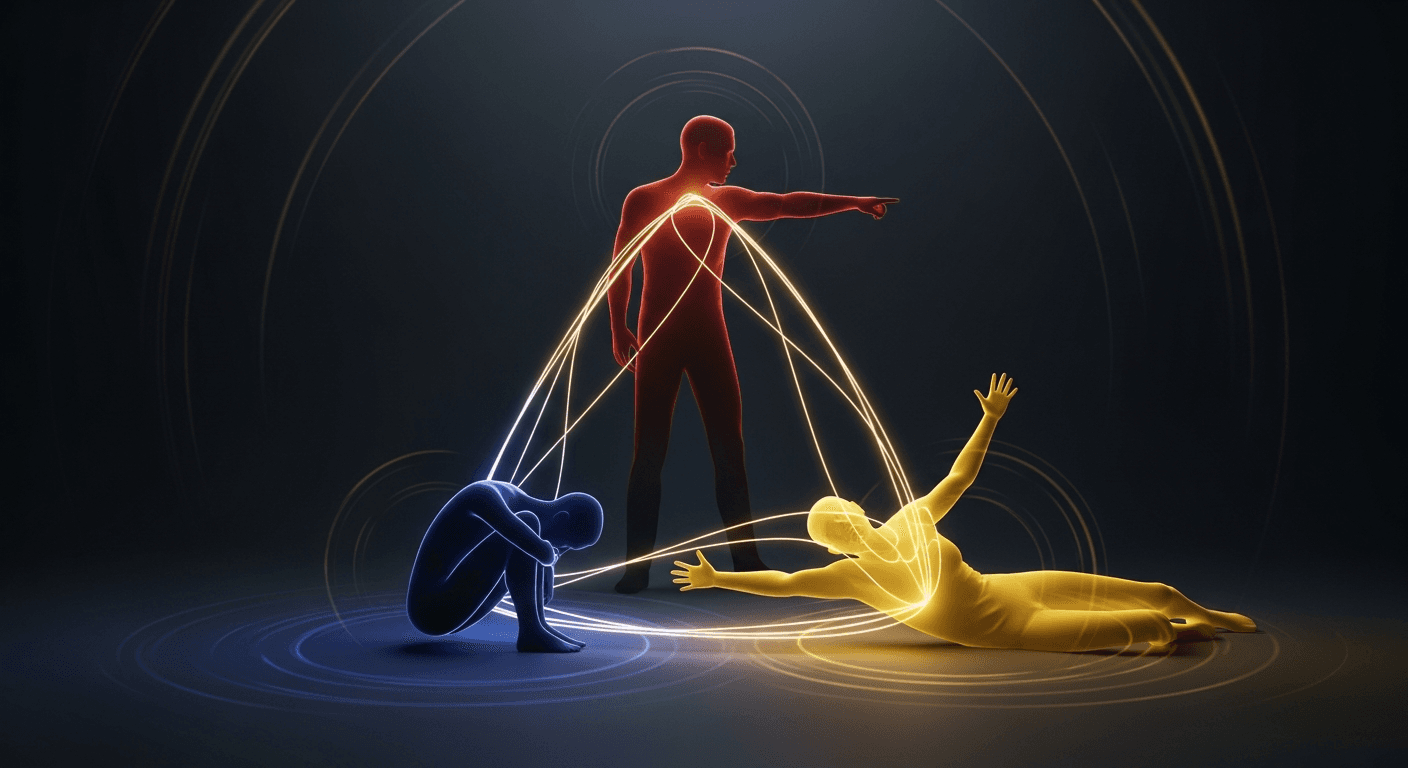
The Karpman Drama Triangle: A Field Guide to Escaping Toxic Patterns
The 1968 psychological framework that explains why your meetings are exhausting, your relationships are draining, and your startup team can't stop fighting.
The Karpman Drama Triangle: A Field Guide to Escaping the Toxic Patterns Destroying Your Relationships, Career, and Startup
The 1968 psychological framework that explains why your meetings are exhausting, your relationships are draining, and your startup team can't stop fighting.
In 1968, a young psychiatrist named Stephen Karpman was studying under Eric Berne, the founder of Transactional Analysis psychology. Karpman had a side interest: he was a member of the Screen Actors Guild. This unusual combination led him to notice something profound about human conflict.
People in dysfunctional relationships weren't just fighting. They were acting. They were playing roles. And those roles cycled between three fixed positions with the predictability of a stage play.
He called it the Drama Triangle.
Fifty-seven years later, this framework remains one of the most powerful tools for understanding why your co-founder meetings feel like battlegrounds, why your family dinners end in silent resentment, and why some people seem magnetically attracted to chaos.
More importantly, it provides a clear map for escaping these patterns entirely.

Watch: The Drama Triangle Explained
A short animated guide to understanding and escaping the Drama Triangle
The Three Roles: Understanding the Stage
The Drama Triangle consists of three positions that people occupy during conflict. Crucially, these aren't personality types—they're roles people switch between, often within the same conversation.
The Victim
The Victim's position: "Poor me. My life is so hard. My life is so unfair."
The Victim feels oppressed, helpless, and powerless. They believe circumstances or other people are causing their problems. Nothing can be done. All attempts are futile, despite trying hard.
Important distinction: This is not about actual victimization. Someone experiencing real trauma or injustice is not "playing Victim." Karpman chose "drama triangle" rather than "conflict triangle" precisely because the Victim in his model represents someone feeling or acting like a victim—not someone who actually is one.
The Victim seeks validation for their helplessness. They're overly sensitive and defensive, often masking feelings of anger, resentment, and unworthiness. In the workplace, the Victim is the colleague who constantly complains about management but never proposes solutions. In relationships, they're the partner who catalogues every wrong done to them while refusing to take any action.
The Persecutor
The Persecutor's position: "It's all your fault. I'm surrounded by fools."
The Persecutor is controlling, blaming, critical, authoritarian, and superior. They attack others to feel powerful and mask their own insecurities. If you've found yourself in an "us versus them" situation at work, you've met a Persecutor. If someone constantly blames "leadership" or "the higher-ups" or "engineering" for every conceivable problem, you've met a Persecutor.
The Persecutor dominates through criticism and blame, prioritizing being right over getting results right. In startups, the Persecutor is the founder who micromanages and criticizes but won't empower their team. In families, they're the parent whose "feedback" is always delivered as judgment.
The Rescuer
The Rescuer's position: "Let me help you. It's my responsibility to fix this."
The Rescuer is the white knight, the savior, the fixer. They rush to solve problems without being asked. They feel guilty if they don't rescue—but their rescuing keeps others dependent and prevents them from developing their own problem-solving capabilities.
Here's the uncomfortable truth: rescuing is often manipulation disguised as help. It keeps the Victim dependent. It maintains the Rescuer's sense of being needed and valuable. The relationship between a habitual Victim and habitual Rescuer is the definition of codependency.
In tech, the Rescuer is the engineering lead who takes over every struggling project instead of coaching their team. In relationships, they're the partner who solves every problem, leaving the other person feeling incompetent and helpless.

The Dance: Why We Switch Roles
The Drama Triangle isn't static. Its power—and its trap—is that participants rotate through all three positions.
Consider this workplace scenario:
Scene 1: Sarah (Engineering Manager) feels overwhelmed by an impossible deadline set by leadership. She vents to Mike (Victim → Rescuer dynamic): "This is ridiculous. They never give us enough time."
Scene 2: Mike, wanting to help, takes over a key component himself (Rescuer). Sarah feels relieved but also slightly undermined.
Scene 3: The component has bugs. Sarah criticizes Mike's approach (now Sarah is Persecutor, Mike is Victim): "This isn't even close to spec. Why didn't you ask first?"
Scene 4: Mike defends himself by blaming the original deadline (now Victim/Persecutor hybrid): "I was trying to help YOU. If leadership hadn't set impossible timelines..."
Scene 5: Leadership hears about the conflict and steps in to "mediate" (Rescuer), making Sarah and Mike feel like children being managed.
One interaction. Five role switches. Everyone leaves feeling drained, resentful, and more entrenched in dysfunction.
The pattern perpetuates because everyone receives a psychological "payoff." The Victim gets their needs met without responsibility. The Rescuer feels useful and important. The Persecutor gets to discharge anger and feel superior. These payoffs keep people trapped even when they consciously want to escape.

Origins: Why We Play These Roles
Participants first learn their habitual roles in their families of origin. A child who grew up with an alcoholic parent might become a lifelong Rescuer, forever trying to "save" people who don't want to be saved. A child who was constantly criticized might oscillate between Victim (internalizing the criticism) and Persecutor (externalizing it onto others).
We bring these patterns into adult relationships, often unconsciously seeking partners, friends, and colleagues who will play complementary roles. A habitual Rescuer attracts habitual Victims. A Persecutor finds someone who will accept their blame. The patterns feel familiar—even when they're destroying us.
This is why breaking the Drama Triangle requires more than just "deciding to be different." The patterns are wired through years of practice. They feel like identity. The escape requires a complete reframe.
The Escape Routes: Two Alternatives to Drama
The Winner's Triangle (Acey Choy, 1990)
Psychologist Acey Choy developed the Winner's Triangle as a direct antidote. It takes each Drama Triangle role and transforms it into a healthy alternative:
Victim → Vulnerable
Instead of helplessness, the Vulnerable person acknowledges their feelings and needs while taking responsibility for finding solutions. They can say "I'm struggling with this" without implying "and you need to fix it for me." Vulnerability is strength because it maintains agency.
Persecutor → Assertive
Instead of attacking and blaming, the Assertive person expresses their needs directly and respectfully. They set boundaries without tearing others down. They can say "This approach isn't working, and here's what I need" without implying "and you're an idiot for not seeing it."
Rescuer → Caring
Instead of taking over, the Caring person offers genuine support while respecting the other person's autonomy. They can say "How can I help?" without implying "I'll do it for you." They believe in the other person's capability to solve their own problems.

The Empowerment Dynamic (David Emerald)
David Emerald's TED framework provides an even more comprehensive reframe, shifting not just the roles but the entire orientation:
Victim → Creator
The Creator takes responsibility and focuses on what they can control. Challenges become growth opportunities rather than evidence of unfair treatment. The fundamental question shifts from "Why is this happening to me?" to "What outcome am I creating?"
Persecutor → Challenger
The Challenger holds people accountable while believing in their potential. They push growth through support rather than criticism. A Challenger says "I believe you can do better, and here's my support" rather than "You failed again."
Rescuer → Coach
The Coach guides others toward their own solutions. They ask questions rather than provide answers. They foster independence and resilience. A Coach asks "What options do you see?" rather than "Here's what you should do."
The FISBE Framework: The Underlying Shift
Emerald identifies the core difference between Drama Triangle and Empowerment Dynamic using the FISBE framework:
| Aspect | Drama Triangle | Empowerment Dynamic |
|---|---|---|
| Focus | Problems and what's wrong | Desired outcomes and possibilities |
| Inner State | Fear, frustration, anxiety | Calm, curiosity, creativity |
| Behavior | Reactive, defensive (fight/flight/freeze) | Proactive, collaborative, empowering |
The core shift is from "Victim Orientation" (the world happens to you) to "Creator Orientation" (the world happens by you).
In Practice: Your Personal Life
Recognizing the Pattern
Your Drama Triangle patterns almost certainly started in your family. Notice when you feel the familiar pull toward a role:
- Do you find yourself telling the same story of unfairness repeatedly? (Victim)
- Do you feel contempt for people who "can't figure things out"? (Persecutor)
- Do you feel compelled to fix problems that aren't yours? (Rescuer)
Breaking the Cycle
-
Name it: Simply saying "I notice I'm in Victim mode right now" breaks the unconscious pattern.
-
Ask Creator questions: Instead of "Why is this happening to me?" ask "What do I actually want here?" and "What's one small thing I can control?"
-
Set boundaries with compassion: You can stop rescuing without abandoning people. "I care about you, and I trust you to figure this out. I'm here if you want to talk through options."
-
Refuse the invitation: When someone invites you into their triangle—venting without wanting solutions, criticizing without accountability—you can simply not enter. "That sounds frustrating. What are you going to do about it?"
In Practice: Your Professional Life
Research shows U.S. employees spend 2.8 hours weekly in conflict, costing $359 billion in lost productivity. Most of that time is spent cycling through Drama Triangles.
As a Leader
The most common trap for leaders is the Rescuer role. You see a struggling team member, you take over their project "just this once," and suddenly you're working weekends while your team never develops problem-solving skills.
The shift: Become a Coach instead. When someone brings you a problem:
- Ask "What options do you see?" before offering any.
- Ask "What would you do if I wasn't available?"
- Say "I trust you to handle this. Let's talk through your approach."
As a Team Member
When you feel pulled into Victim mode by organizational dysfunction—unrealistic deadlines, poor communication, lack of resources—the temptation is to commiserate with colleagues. This feels good but changes nothing.
The shift: Become a Creator. Ask yourself: "Given the constraints I actually have, what outcome can I create?" Then propose solutions rather than just cataloguing problems.
In Meetings
Notice when meetings become Drama Triangle theater. Someone vents about another team (Victim/Persecutor). Someone else offers to "talk to them" (Rescuer). The cycle perpetuates.
The shift: Interrupt the pattern with Creator questions: "What outcome are we trying to achieve here?" and "What's within our control to change?"

In Practice: Tech Startups
Startups are Drama Triangle accelerators. High stakes, limited resources, interpersonal pressure, and unclear roles create perfect conditions for dysfunction.
The Founder's Trap
One executive coach describes a common pattern: founders or executives venting angrily about employees, partners, or investors who are not meeting their expectations. They oscillate between Persecutor ("This is unacceptable") and Victim ("After everything I've done") and Rescuer ("I'll just do it myself").
Case Study: Maya, COO of a fintech startup, bounced between Persecutor ("Fix this now!") and Rescuer ("I'll handle it") with her engineering lead. After mapping incidents on the triangle, she practiced the Creator question: "What outcome are we designing?"
She shifted to Coach by asking, "What's the smallest change you can ship this sprint?" Within two months, the lead owned a new quality-check protocol. Maya reported a 60% drop in weekend work and a 15% rise in team satisfaction scores.
The Co-Founder Dynamic
Co-founder conflict often follows Drama Triangle patterns:
- One co-founder feels they're "doing all the work" (Victim)
- They criticize the other's contributions (Persecutor)
- The other defends by attacking back or withdrawing (Victim/Persecutor)
- Someone external (investor, advisor) tries to mediate (Rescuer)
The shift: Explicit agreements about roles, regular check-ins focused on outcomes not blame, and a shared commitment to calling out Drama Triangle patterns when they emerge.
Building Psychologically Safe Teams
The Drama Triangle thrives in environments lacking psychological safety. Teams that can't have honest conversations default to indirect conflict patterns.
Practical tools:
- Feedback Wraps: Structured feedback that separates observation from judgment
- Personal Maps: Understanding teammates' communication styles and triggers
- Retrospectives: Regular spaces for honest conversation about team dynamics
- The "Drama Triangle Check-In": Start difficult meetings by asking "What role am I tempted to play right now?"
The Path Forward
The Drama Triangle isn't destiny. It's a learned pattern, and learned patterns can be unlearned.
Start by building consciousness. Notice which role you habitually play. Notice when you're invited into someone else's triangle. Notice the payoffs you receive for staying in the drama.
Then practice the shift:
- From Victim to Creator: "What outcome do I want? What can I control?"
- From Persecutor to Challenger: "How can I push for accountability while maintaining belief in this person's potential?"
- From Rescuer to Coach: "How can I support without taking over? What question would help them find their own solution?"
The world doesn't change overnight. Your family dynamics won't transform because you read a blog post. Your startup team won't suddenly communicate perfectly.
But every time you notice the pattern and choose differently, you weaken the Drama Triangle's grip. Every time you respond as Creator instead of Victim, as Coach instead of Rescuer, as Challenger instead of Persecutor, you build new neural pathways.
The drama is optional. The alternative is available. The choice is yours.
Further Reading
- The Power of TED (The Empowerment Dynamic) by David Emerald
- "The Winner's Triangle" by Acey Choy (Transactional Analysis Journal, 1990)
- "A Game Free Life" by Stephen Karpman
- The Compassion Triangle - Karpman's later work on finding "10% forgivable reasons" for each role
See also: What Naruto Taught Me About Escaping the Victim Mindset — How anime illustrates the Creator mindset for builders
Written by
Global Builders Club
Global Builders Club
If you found this content valuable, consider donating with crypto.
Suggested Donation: $5-15
Donation Wallet:
0xEc8d88...6EBdF8Accepts:
Supported Chains:
Your support helps Global Builders Club continue creating valuable content and events for the community.