
The Kill Line: How a Gaming Term Exposed the Fragility of the American Dream
A Chinese forensic assistant in Seattle coined a phrase that's reshaping how the world sees America—and revealing universal truths about economic precarity.
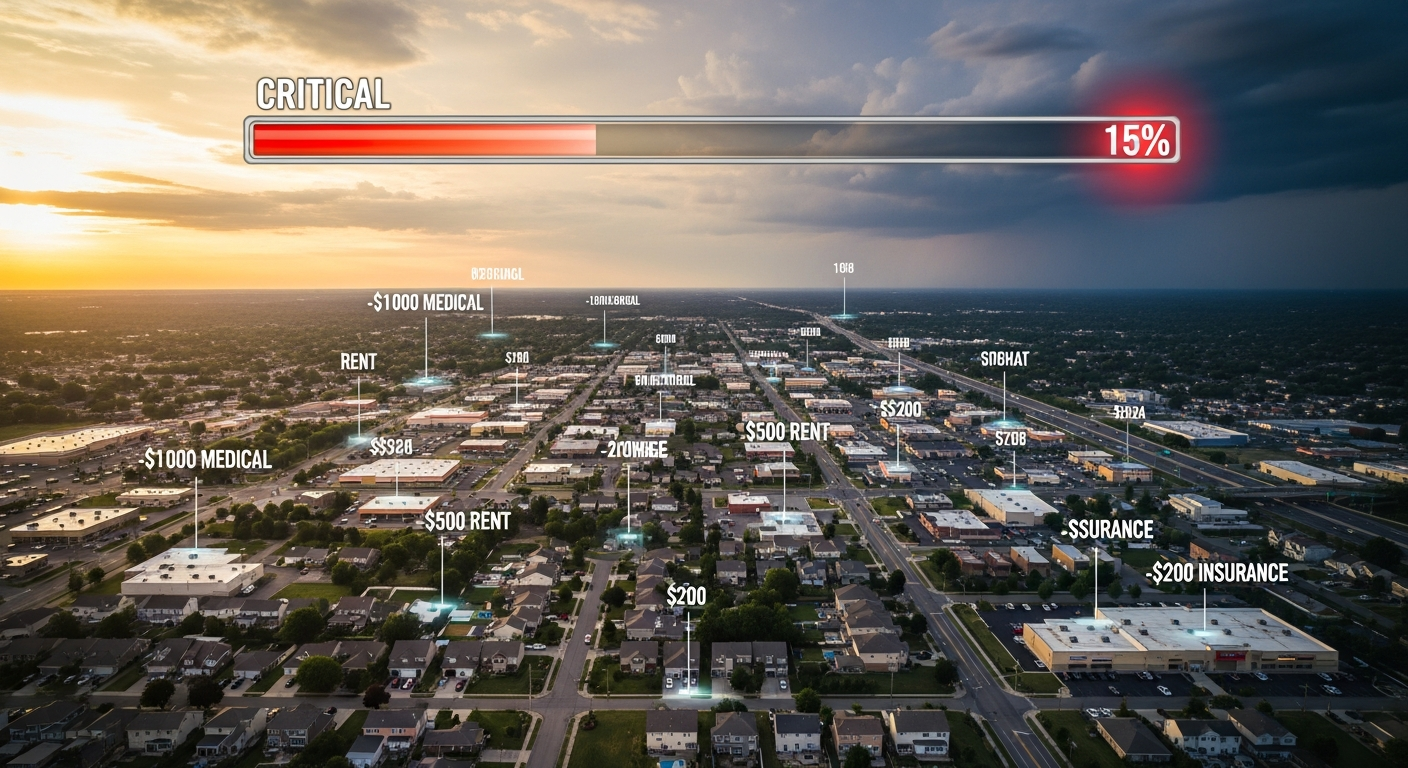
In video games, there's a concept called the "kill line." It's the health threshold below which any attack becomes fatal. Your character has no buffer left—one hit and you're dead. No recovery, no respawn, no second chance.
In late 2025, a Chinese content creator working as a forensic assistant in Seattle borrowed this term and applied it to something far more real: the American economy.
His name is Sikuiqidawang, and his Bilibili videos documenting life on the margins of American society—unclaimed bodies in morgues, homeless encampments in the rain, workers one paycheck from disaster—went massively viral. Within a month, he gained 500,000 followers. The term "kill line" exploded across Chinese social media.
But the concept resonated far beyond propaganda. It resonated because it's true.
The Statistics Behind the Metaphor
The kill line isn't hyperbole. The numbers are stark:
- 67% of American workers live paycheck to paycheck (PNC Bank 2025)
- 40% of American adults cannot cover a $400 emergency without borrowing or selling possessions (Federal Reserve)
- 59% cannot handle a $1,000 surprise expense (Bankrate)
- 771,480 Americans were homeless as of late 2024
The viral story that crystallized the concept: a Meta senior engineer earning $450,000 annually became homeless within six months of layoff. High income provides no immunity. The kill line doesn't care about your salary—it cares about your buffer.

The Cascade
What makes the kill line so lethal isn't just the initial shock. It's the cascade.
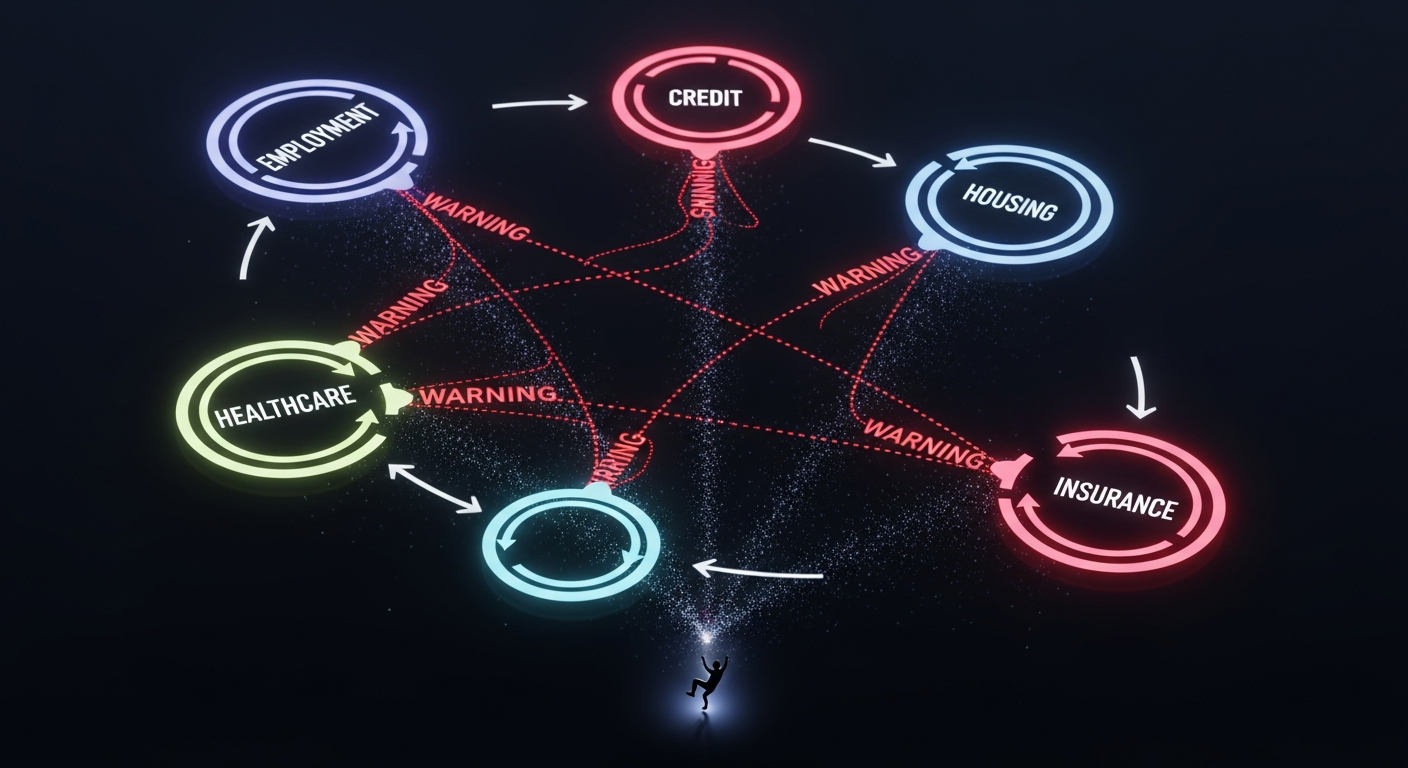
When someone loses their job, interconnected systems activate against them:
- Income stops → Miss a payment
- Credit score drops → Interest rates rise, new credit denied
- Insurance lapses → Medical vulnerability increases
- Housing destabilizes → Foreclosure or eviction risk
- Employment barriers multiply → Bad credit, no address, health problems make hiring harder
- Recovery becomes impossible → Below the kill line
Each system contains triggers that activate barriers in other systems. The floor isn't solid ground—it's a trapdoor leading to another floor, then another, until you're in freefall with nothing to grab.
A China Daily analysis captured it precisely: these mechanisms function as "a governing technique—an 'invisible rule' used to sort, discipline and exclude."
The Philosophy Beneath the Policy
Why does America have such a lethal floor alongside its famously high ceiling?
The answer lies in foundational philosophy. John Locke wrote in 1689 that government exists primarily "for the preservation of their property." This property-first framework produced predictable downstream effects:
- Limited government ideology
- Market outcomes treated as moral judgments
- Welfare framed as personal responsibility
- Safety nets designed as temporary embarrassments rather than permanent infrastructure
Professor Shen Yi of Fudan University called it "the core mechanism of American capitalism—a tacitly accepted system embedding social Darwinism principles within fundamental American economic rules."
The kill line isn't a bug. It's a feature.
The Mirror Effect
China deployed the kill line concept as propaganda, contrasting American fragility with Chinese stability. State media amplified stories of homeless Americans, bankrupt families, and collapsing middle-class dreams.
But then something unexpected happened.
Chinese users turned the metaphor inward. By December 2025, a new phrase emerged: the "35-year-old kill line"—describing age-based hiring discrimination where workers over 35 face severe employment barriers in China.
On January 14, 2026, Weibo began censoring kill line discussions. Comparative posts between American and Chinese economic vulnerability started disappearing.
The propaganda had become a mirror. The metaphor meant to criticize capitalism reflected anxieties that transcend national boundaries. Every system, it turns out, has a kill line. The manifestations differ, but the precarity is universal.
The Cultural Buffer China Claims
CGTN's analysis identified why China claims no kill line exists within its borders:
Cultural foundations:
- Centuries of savings culture ("preparing for a rainy day")
- Confucian family structures where "the elderly are cared for, the capable employed, and the young nurtured"
- Multi-generational households providing mutual support
Institutional protections:
- 95%+ enrollment in basic medical insurance
- Regional coordination between wealthy and developing provinces
- Minimum livelihood guarantees (dibao)
The insight isn't that China is superior. It's that informal networks—family, community, cultural practices—function as safety nets where formal institutions fail. American individualism, often celebrated, may actually increase fragility by eliminating these buffers.
The Exit Strategies
If the existing system has a kill line by design, some are choosing to exit rather than reform.
Network States:
Balaji Srinivasan's concept envisions digital communities that crowdfund physical territory, build parallel institutions, and eventually seek diplomatic recognition. His Network School in Malaysia houses 256 members paying $1,500/month for accommodation, meals, coworking, and community—a miniature experiment in alternative social contracts.
Praxis, backed by Peter Thiel and others, has raised $525 million to build an alternative city. The original Mediterranean plan failed; now they're looking at Greenland.
The vision: choose citizenship like a gym membership, opting into communities whose social contracts match your values.
AI-Augmented Democracy:
Yale's IWORD conference explored technology-enabled reform within existing systems:
- AI-augmented citizens' assemblies
- Digital deliberation with decentralized identity
- Transitioning from consumer-centric to citizen-centric institutional models
The debate between "voice" (reforming from within) and "exit" (building alternatives) may define our generation's political imagination.

What the Kill Line Teaches Us
The concept's viral spread reveals several truths:
1. Fragility is structural, not personal. Falling below the kill line isn't moral failure. It's what happens when systems designed for property preservation encounter human lives.
2. Informal networks matter. Family, community, mutual aid—these aren't sentimental luxuries but genuine safety infrastructure. American individualism may reduce economic dynamism by eliminating fallback options.
3. Technology cuts both ways. Algorithmic credit scoring accelerates cascades. But decentralized identity and community DAOs could raise the kill line through distributed coordination.
4. Every system has a kill line. China has age discrimination. America has medical bankruptcy. The question isn't whether kill lines exist but what we do about them.
The Future of the American Dream
The kill line discourse marks a turning point. For decades, the American Dream's mythology circulated globally—opportunity for all, upward mobility through hard work, the shining city on a hill.
The mythology is collapsing.
Not because America lacks opportunity—it doesn't—but because the floor has become lethal. You can rise spectacularly, but you can also fall so fast and so far that recovery becomes impossible.
Three paths forward emerge:
Voice: Reform existing institutions. Universal healthcare, basic income, housing guarantees. The New Deal transformed capitalism once; it can happen again.
Exit: Build alternative communities. Network states, startup societies, parallel institutions. Don't wait for reform—construct new social contracts now.
Synthesis: Use technology to strengthen existing communities while experimenting with new forms. Decentralized safety nets. AI-augmented deliberation. Community coordination at scale.
The most likely future involves all three—a patchwork of reformed institutions, experimental communities, and technological tools creating uneven safety nets. The kill line won't disappear, but its height might vary by community.
Conclusion
Sikuiqidawang's gaming metaphor captured something academic economics had obscured: the visceral reality of American precarity. Kill line communicates what "asset-limited income-constrained employed" never could.
For those of us living through this moment, the concept offers both warning and possibility.
The warning: The floor is closer than you think. 67% of Americans are one hit from fatal damage. Build your buffer—financial, social, communal—while you can.
The possibility: Communities can be built that raise the kill line. Whether through reformed institutions, alternative societies, or technological coordination, we can design systems where one shock doesn't equal irreversible collapse.
The American Dream isn't dead. But it needs new architecture.
The question is whether we'll build it—through voice, through exit, or through some combination yet to be imagined.
What's your buffer from the kill line?
Written by
Global Builders Club
Global Builders Club
If you found this content valuable, consider donating with crypto.
Suggested Donation: $5-15
Donation Wallet:
0xEc8d88...6EBdF8Accepts:
Supported Chains:
Your support helps Global Builders Club continue creating valuable content and events for the community.