The Superhuman Stack: How Spatial Computing, AI Agents, and d/acc Converge in 2026
The future isn't one technology. It's the convergence of spatial computing, AI agents, and defensive accelerationism into a new paradigm for human capability.
The Superhuman Stack: How Spatial Computing, AI Agents, and d/acc Converge in 2026
The future isn't one technology. It's the convergence.
The Bloomberg Terminal of 2030
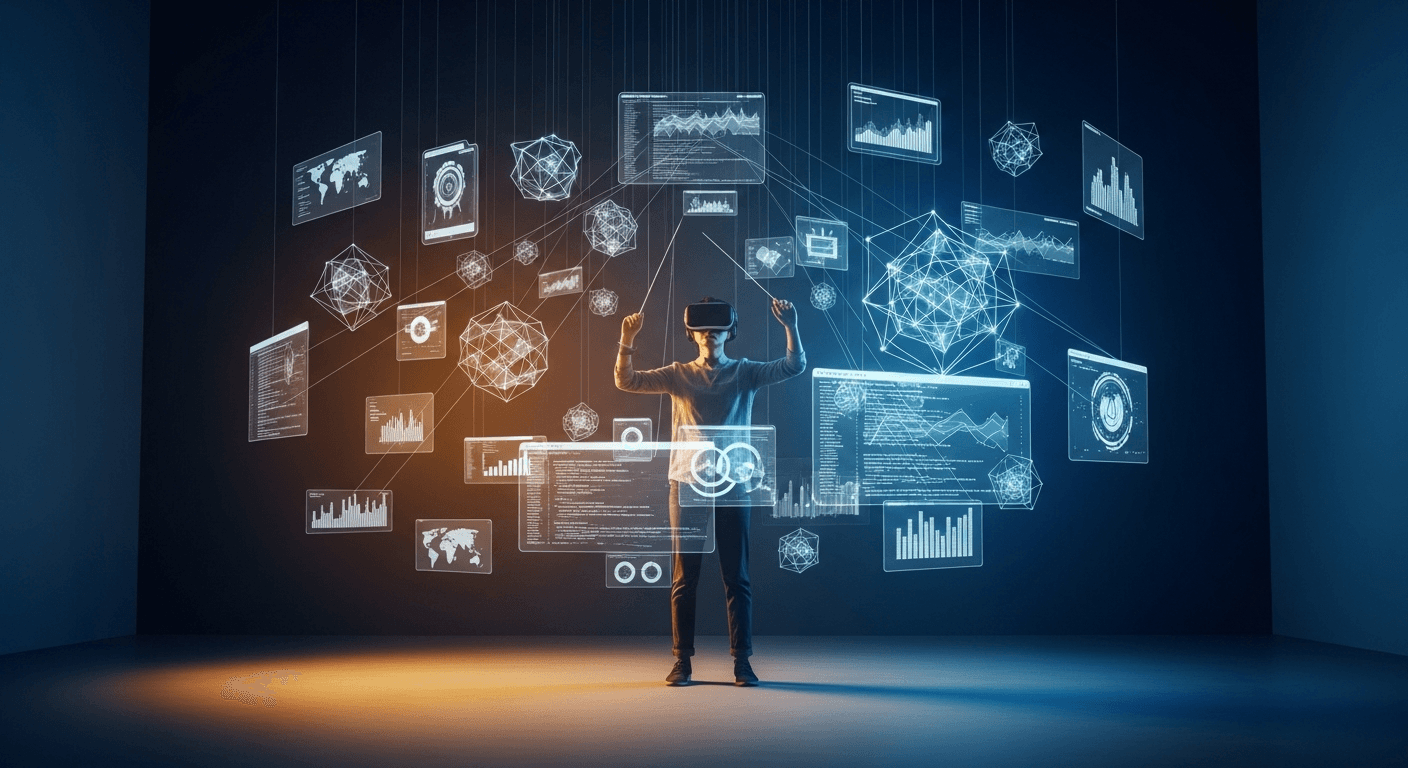
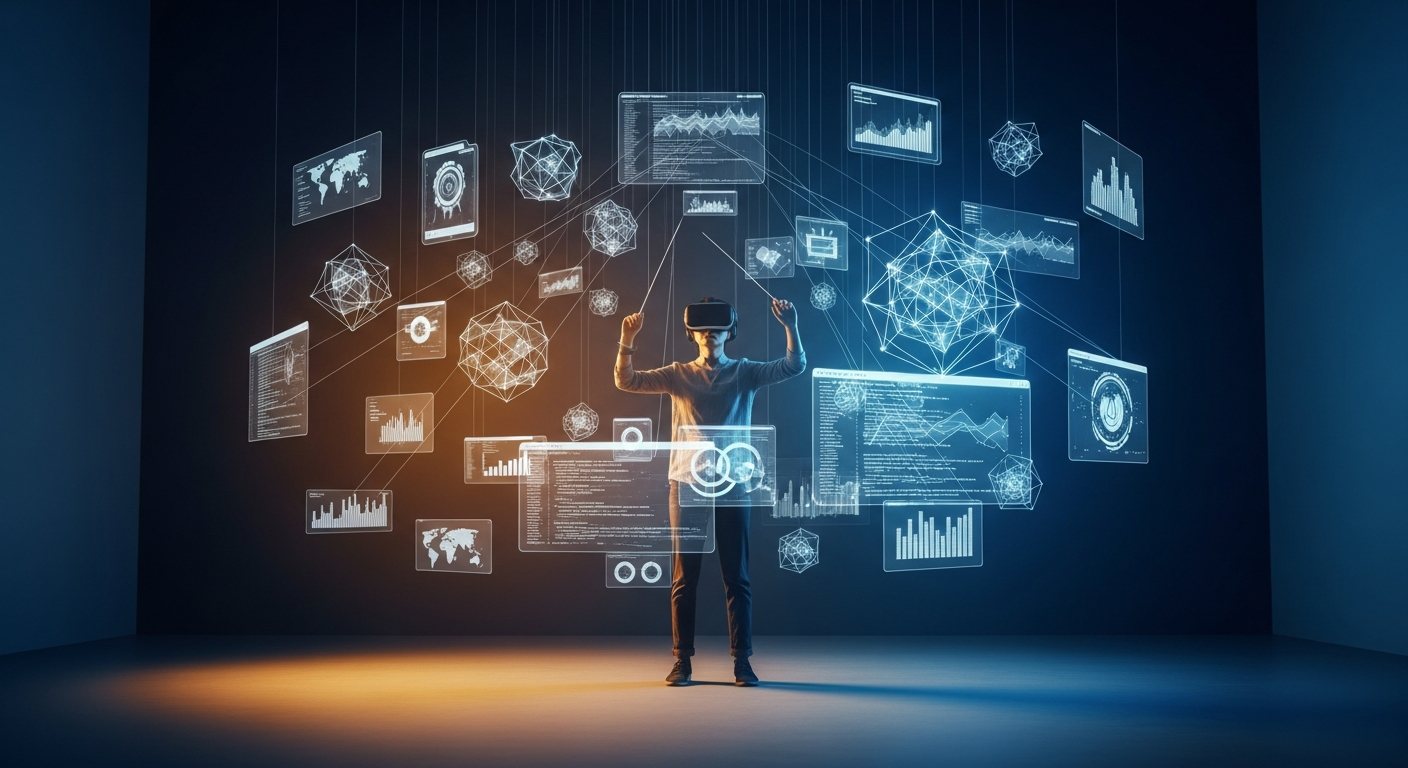
Picture this: You're wearing Vision Pro 3. Around you, floating in three-dimensional space, are live market feeds rendered as flowing data structures. Patterns emerge not from squinting at flat charts but from watching information move through space the way your brain naturally processes the physical world.
You speak: "Show me correlation anomalies in tech sector, overlay with Fed commentary sentiment, highlight prediction market confidence levels."
Within seconds, multiple AI agents—each specialized, each working in parallel—gather data, analyze patterns, synthesize findings, and render the results as an explorable 3D visualization hovering in your peripheral vision.
You don't code. You don't click. You don't scroll through spreadsheets.
You command.
This isn't science fiction. Bloomberg is already researching XR data visualization with the Immersive Analytics Toolkit. The spatial computing market is projected to grow from $135 billion in 2024 to over $1 trillion by 2034. And AI agent orchestration is moving from experimental to mainstream—40% of enterprise applications will embed autonomous agents by end of 2026.
The pieces are converging. The question is: who will assemble them?
The Problem with Screens
We've been cramming increasingly complex information through 2D rectangles since the 1980s.
Financial traders stack six to eight monitors. Data scientists scroll through endless tables. Knowledge workers toggle between dozens of tabs. The interface hasn't fundamentally evolved, even as the complexity of work has increased by orders of magnitude.
The result? Cognitive overload. Context switching. Missed patterns hiding in plain sight.
Spatial computing offers a different paradigm entirely:
- Infinite canvas — No monitor limits, information arranged in 3D space around you
- Natural interaction — Gestures, gaze, and voice instead of mouse and keyboard
- Immersive focus — Distraction-free environments for deep work
- Embodied cognition — Spatial memory aids understanding in ways flat screens never could
Your brain evolved to navigate three-dimensional environments. Why are we still forcing it to process information through tiny 2D windows?

The 1000x Conductor
Stanford economist Erik Brynjolfsson frames it elegantly: all work consists of asking questions, executing solutions, and evaluating results.
AI has become exceptionally capable at execution—the middle phase. Human value is consolidating into the bookends: knowing what to build and knowing if it worked.
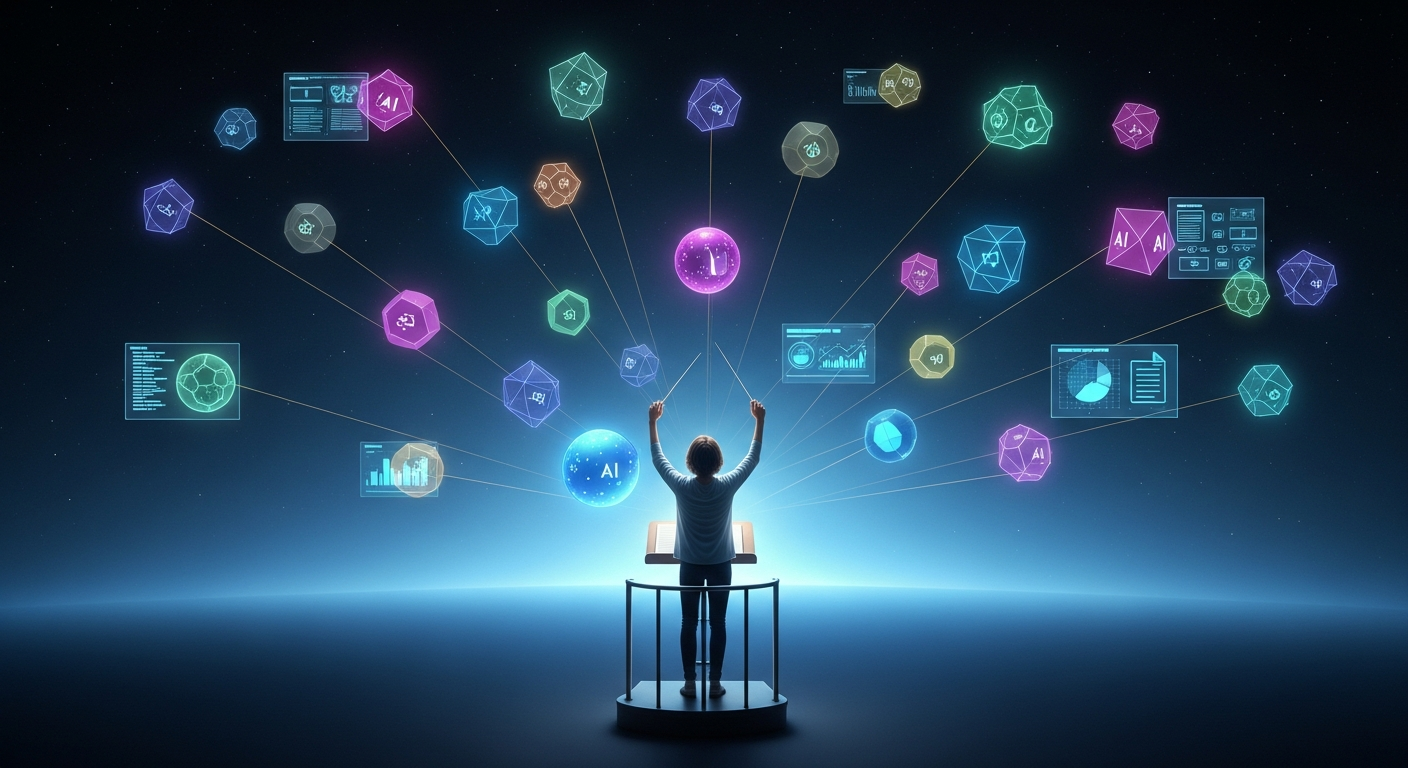
This creates a new archetype: the 1000x conductor.
The "10x engineer" was someone who could produce 10x the output of an average engineer. The 1000x conductor is someone who:
- Orchestrates multiple AI agents simultaneously
- Directs without executing
- Maintains context across complex projects
- Exercises judgment at key decision points
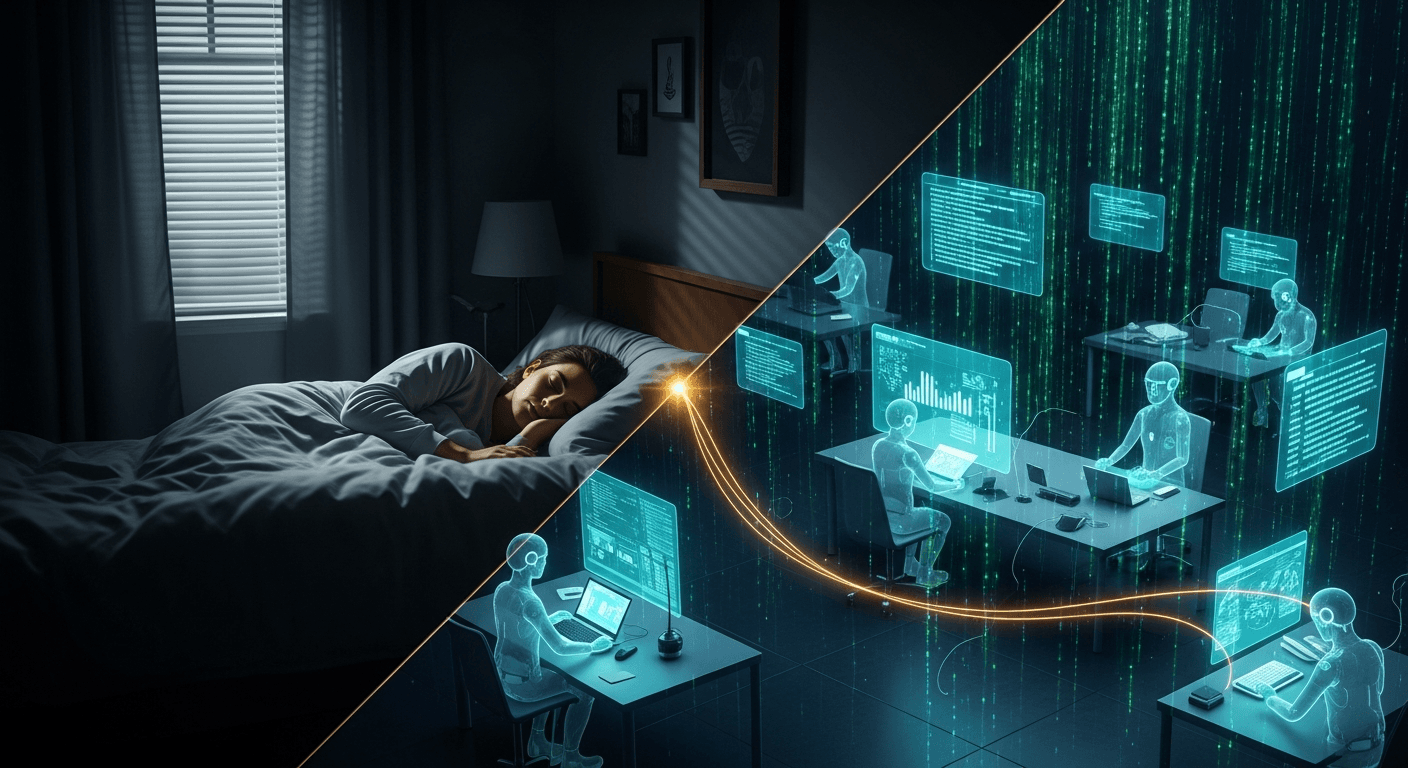
One person can now accomplish what previously required entire teams. Not by working harder or faster, but by commanding digital workers who never sleep, never forget, and continuously improve.
The market data supports this transition:
- 40% of enterprise applications will embed AI agents by end of 2026 (Gartner)
- 79% of companies are already using agentic AI (PwC)
- 37% of companies expect to replace jobs with AI by end of 2026
- GitHub's vision: 1 billion developers (up from millions today)
Natural language is becoming the primary programming interface. The question isn't whether this transition happens—it's who will be conducting and who will be replaced.
The Thousand-Advisor Vision
Imagine having access to:
- A world-class analyst team monitoring your industry 24/7
- A content production studio creating in your voice
- Financial advisors optimizing your portfolio while you sleep
- Health coaches synthesizing your biometric data into actionable insights
- Career strategists identifying opportunities before they're public
This was previously available only to:
- Billionaires with personal staff
- Executives with corporate resources
- Celebrities with production teams
What changed? Cost curves collapsed.
What previously required $1M+ in annual salaries now costs hundreds per month in AI subscriptions. The capability operates 24/7 without fatigue. It scales with your needs. It improves continuously.
The playing field hasn't just leveled—it's inverted. A thoughtful individual with AI tools can now outperform teams at established companies still debating whether to adopt AI.
d/acc: The Ethical Framework
The AI discourse has been trapped between two poles:
e/acc (effective accelerationism): Maximize progress, consequences be damned. Build faster, ask questions never.
Doomerism: AI is existentially dangerous. Pause development. Maybe stop forever.
Vitalik Buterin offers a third path: d/acc—defensive, decentralized, democratic, differential accelerationism.
The core insight: not all technology development is equal. Some technologies favor attackers (bioweapons, surveillance tools). Some favor defenders (vaccines, encryption, verification systems).
d/acc says: accelerate the defensive technologies. Build systems that empower individuals, not systems that concentrate control.
Applied to AI, this means:
- User sovereignty — You control your AI, your data, your outputs
- Transparency — No black boxes, show the work
- Portability — Export everything, no vendor lock-in
- Verification — Cryptographic proof of claims
- Resilience — Systems that survive individual failures
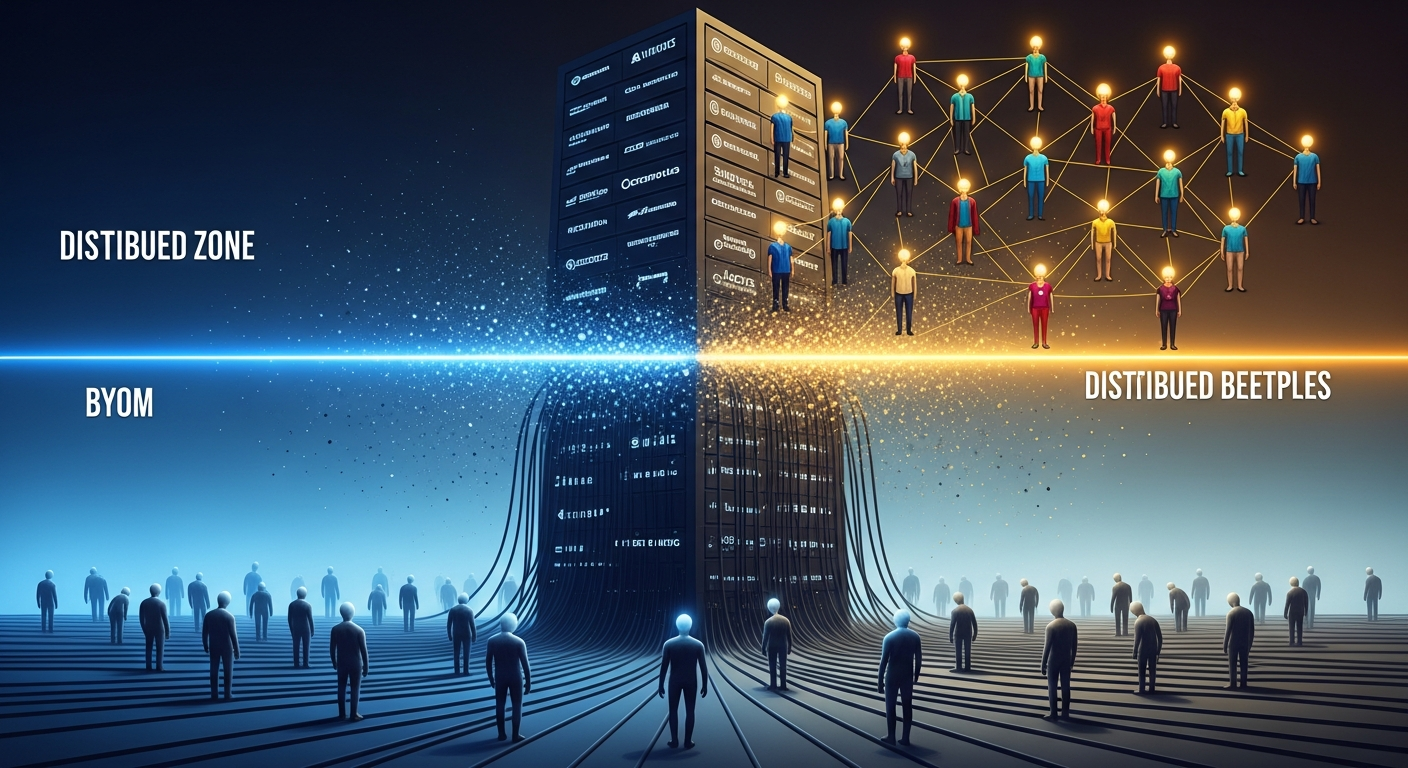
The alternative is corporate AI: closed systems where you're the product, subscriptions that trap your data, black boxes you can't verify, power concentrated in a few companies.
The 2020s will determine which model wins.
Prediction Markets as Decision Infrastructure
Vitalik Buterin's concept of "information finance"—using financial markets to surface accurate information about the future—is becoming real infrastructure.
Polymarket's $9 billion valuation and $9+ billion in 2024 trading volume proves the model works. The 2024 election demonstrated prediction markets' accuracy to mainstream audiences in a way decades of academic papers couldn't.
But this is just the beginning.
The future isn't just humans betting on outcomes. It's:
- AI agents analyzing information and placing bets
- Market signals informing AI recommendations
- Personal prediction portfolios about your own career and goals
- Futarchy-style decision-making in organizations
Imagine an AI advisor that doesn't just give opinions—it has skin in the game through prediction markets. Its track record is verifiable. Its confidence is quantified.
This is decision support with accountability built in.
The Convergence: What Augmi Is Building
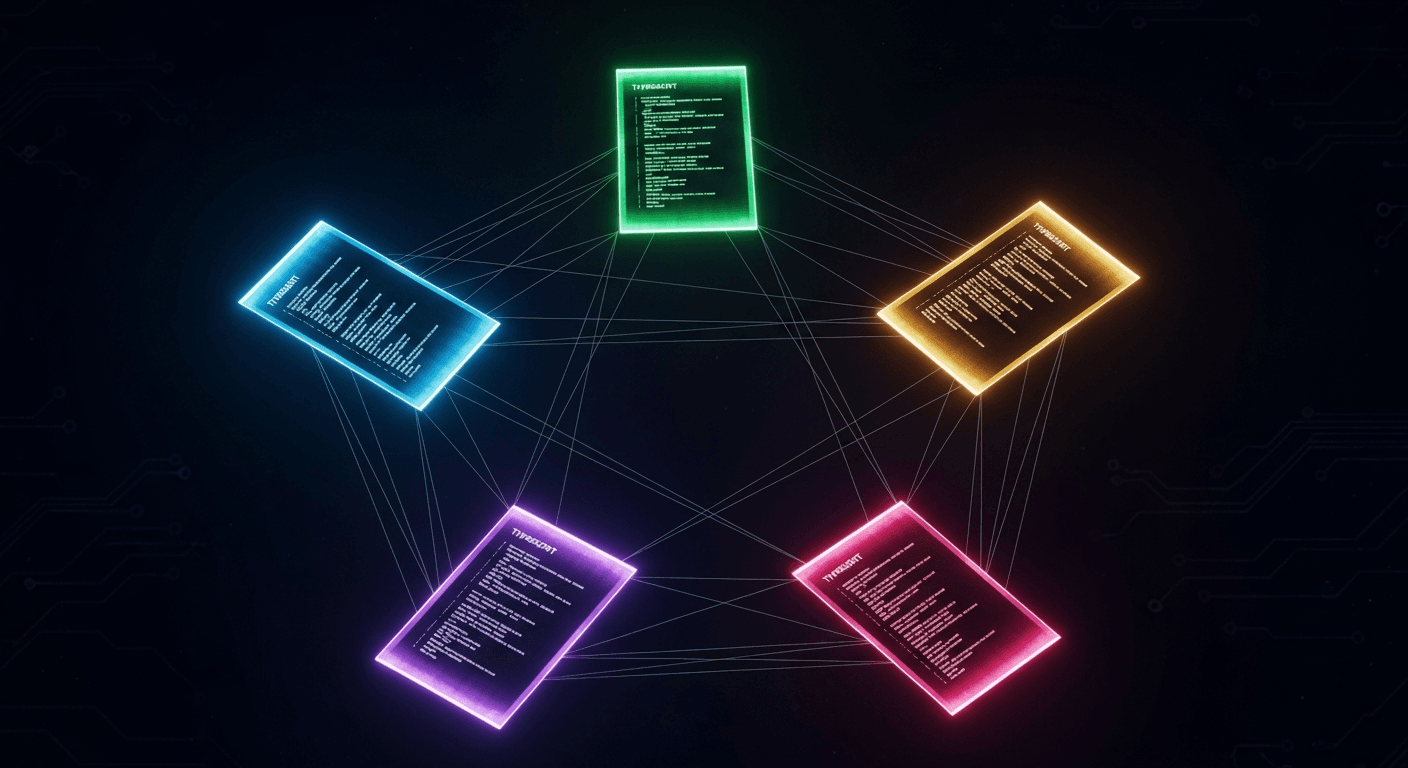
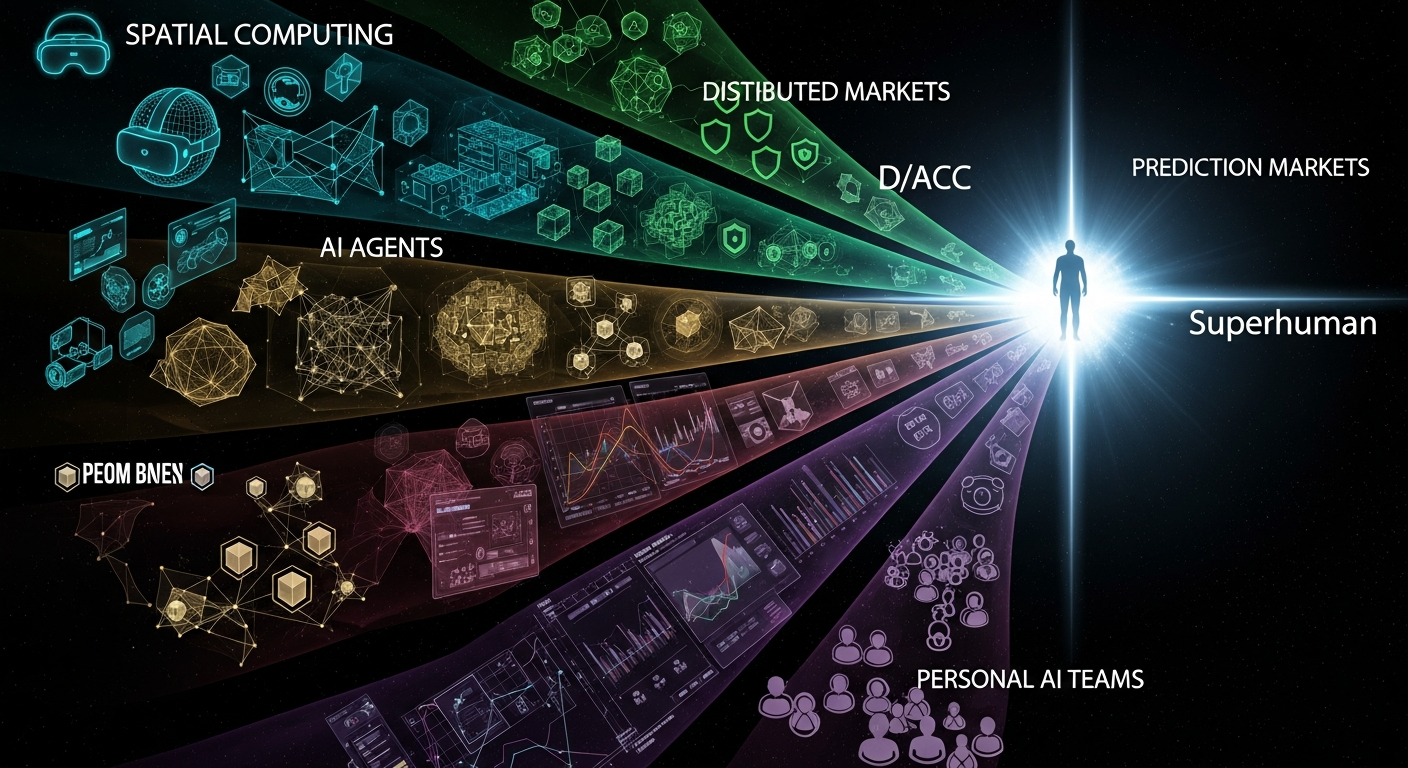
These five threads—spatial computing, AI agent orchestration, personal AI teams, d/acc philosophy, and prediction markets—are converging into something new.
At Augmi, we call it the Superhuman Stack:
Human Layer:     Vision | Judgment | Creativity | Relationships
                              ↓
Augmi Layer:     Execution | Analysis | Visualization | Verification
                              ↓
Output:          Production software in hours | Content in minutes | Decisions with data
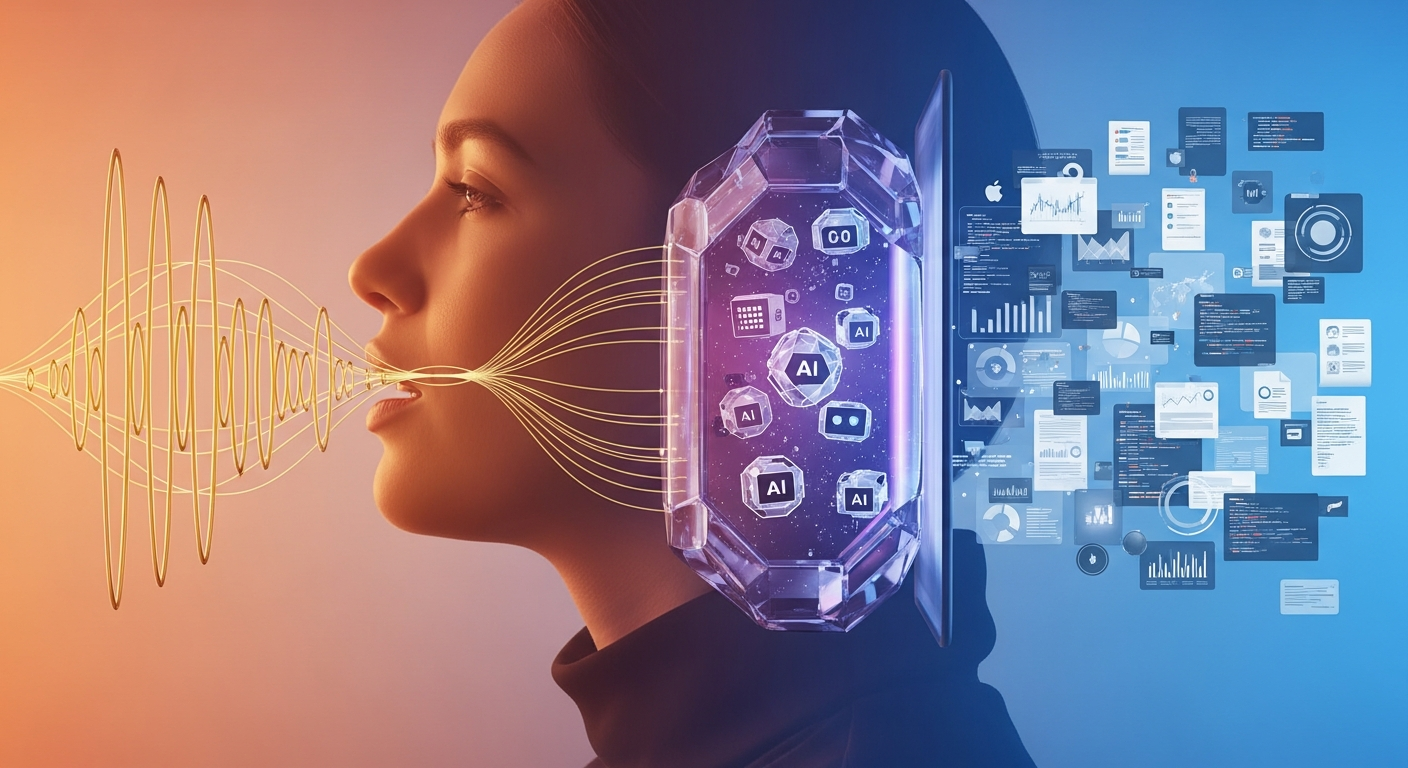
The promise: Voice In → AI Agents Execute → Visual Clarity Out
You speak. AI agents build apps, analyze data, generate visualizations, deploy smart contracts, and handle complex execution. You see everything happening in real-time through visual comprehension. You stay in control.
You become superhuman.
The d/acc Difference
Why build this way? Because the alternative is terrifying.
Corporate AI concentrates power. It creates dependency. It extracts value from users while giving them just enough capability to stay subscribed.
d/acc AI distributes power. It creates sovereignty. It makes users more capable and more independent simultaneously.
Augmi's core values aren't marketing copy—they're architectural decisions:
- Transparency — Show our work, no black boxes
- Ownership — Your work, your keys, your future
- 100% exportable — Everything you create, you can take with you
- Crypto-native — Verifiable, portable, owned
We're not building a product. We're building infrastructure for a new kind of human.
The Roadmap
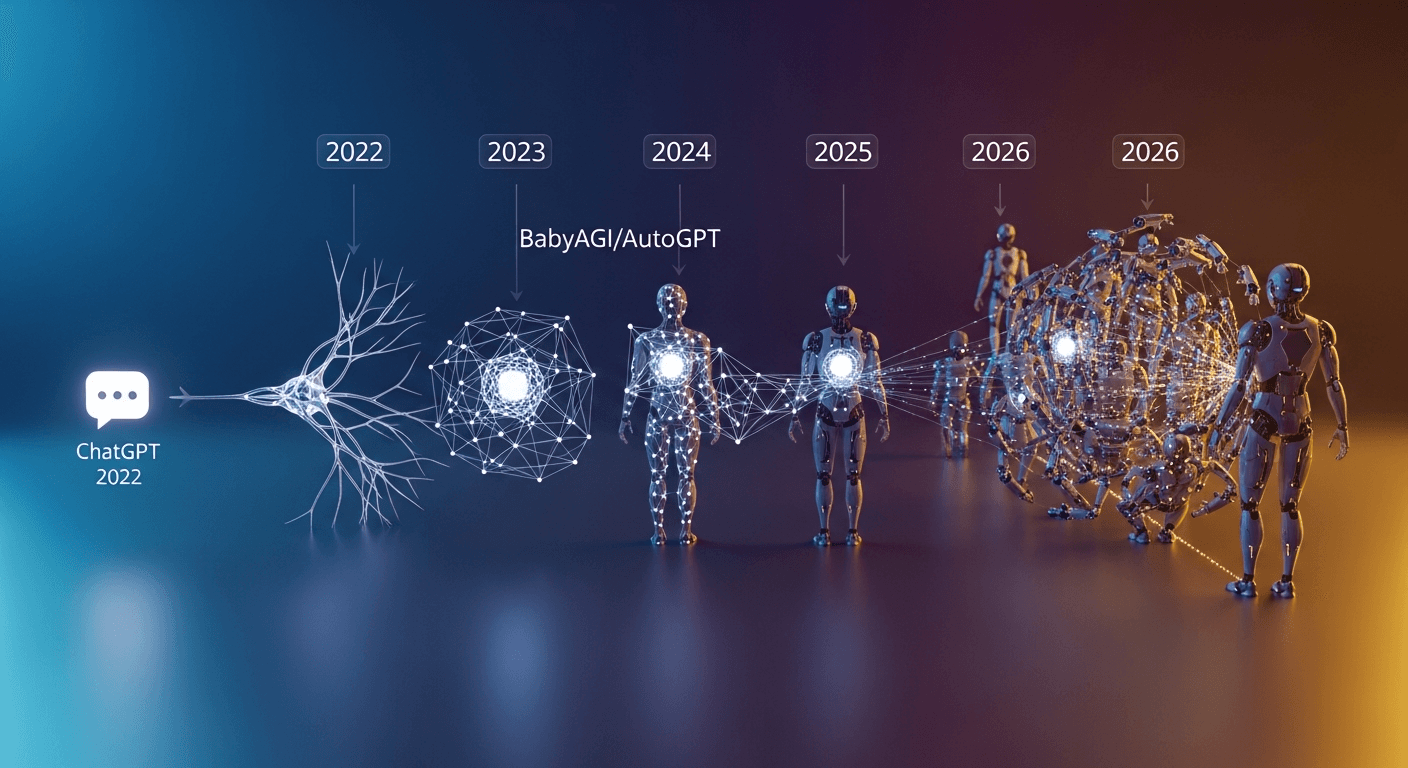
Phase 1 (Now): Web-based agent orchestration with voice input and visual output
Phase 2 (2026): Vision Pro integration, spatial data visualization
Phase 3 (2027+): Robotics integration, physical-world agent execution
2029 Vision: The visual operating system where AI agents amplify human capability across every domain—making complexity comprehensible and execution effortless for everyone.
What This Means for You
If you're reading this, you have a choice to make.
You can wait. Watch the convergence happen. Adopt tools after they're commoditized. Compete on the same playing field as everyone else.
Or you can start now. Develop AI fluency. Invest in judgment over execution skills. Build portable identity that exists independently of any single employer.
The 10x engineer is becoming the 1000x conductor. The question is whether you're conducting or being replaced.
The Question
We end with the same question that started this research:
What will you do with your extra 40 hours a week in the superhuman future?
The technology exists. The convergence is happening. The cost curves have collapsed.
The only variable left is you.
Augmi is building the Superhuman Platform. Voice in. Agents execute. Visual clarity out.
Learn more at augmi.lol
Sources
- Precedence Research - Spatial Computing Market Report (2024-2034)
- Gartner - AI Agent Market Forecast 2026
- PwC - Global AI Adoption Study
- Stanford HAI - The Future of Work with AI
- Vitalik Buterin - Essays on d/acc and Information Finance
- Bloomberg - XR Data Visualization Research (IATK)
- ICE/Polymarket Investment Announcements
- Augmi Mission Statement v3.0
Written by
Global Builders Club
Global Builders Club
If you found this content valuable, consider donating with crypto.
Suggested Donation: $5-15
Donation Wallet:
0xEc8d88...6EBdF8Accepts:
Supported Chains:
Your support helps Global Builders Club continue creating valuable content and events for the community.