Transhumanism: Engineering the Human Condition - A Comprehensive Guide to Humanity's Next Chapter
From Russian Cosmism to the Technological Singularity: exploring the history, philosophy, and current state of the movement to transcend human limitations.
Transhumanism: Engineering the Human Condition
A deep dive into the movement that believes humanity can—and should—transcend its biological limitations
What if aging wasn't inevitable? What if death was merely a technical problem to be solved? What if the limits of human intelligence, strength, and perception were just engineering challenges waiting for the right technology?
These aren't questions from science fiction. They're the core premises of Transhumanism—a philosophical and cultural movement that has grown from fringe speculation into a serious intellectual tradition with billions of dollars in research funding and some of the world's brightest minds working toward its goals.
Roberto Manzocco's comprehensive book Transhumanism - Engineering the Human Condition: History, Philosophy and Current Status provides the definitive academic treatment of this movement. Here's what every builder and technologist should know.
The Surprising Origins: Russian Cosmism
Transhumanism didn't emerge from Silicon Valley. Its intellectual roots trace back to 19th century Russia and a peculiar fusion of Orthodox Christianity, philosophy, and proto-scientific speculation known as Russian Cosmism.
The movement's grandfather is Nikolai Fedorovich Fedorov (1828-1903), a Moscow librarian and ascetic philosopher who proposed what he called the "Common Task": the physical resurrection of all dead ancestors through future technology, followed by humanity's colonization of the cosmos to house them.
Fedorov believed that:
- Death is humanity's primary enemy and must be conquered
- Science and technology are the tools for this conquest
- Humanity has a moral obligation to resurrect the dead
- Space colonization is necessary to accommodate the resurrected billions

This may sound eccentric, but Fedorov's ideas directly influenced Konstantin Tsiolkovsky, the father of Russian rocketry, who developed the mathematical foundations for space travel while explicitly pursuing Fedorov's cosmic vision. The line from Russian Cosmism to the Soviet space program is direct and documented.
The Six Pillars of Transhumanism
Modern transhumanism coalesces around six core technological aspirations—what Manzocco calls "the pillars of Transhumanism":
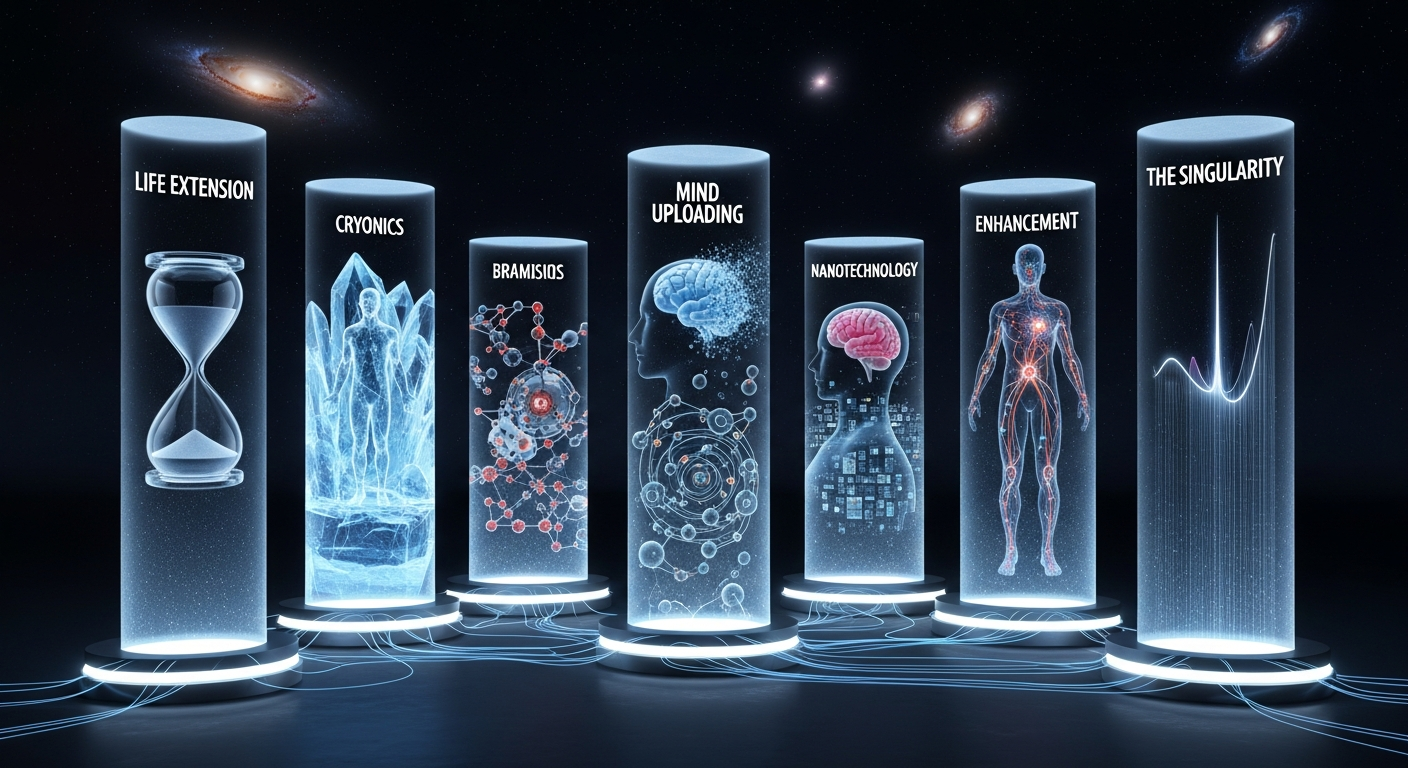
1. Life Extension
The elimination of aging as a cause of death. Aubrey de Grey's SENS (Strategies for Engineered Negligible Senescence) program identifies seven types of cellular and molecular damage that cause aging:
- Mitochondrial mutations
- Intracellular junk (lipofuscin)
- Extracellular junk (amyloid plaques)
- Cell loss and tissue atrophy
- Cell senescence (zombie cells)
- Extracellular crosslinks (AGE)
- Cancer
De Grey's insight: we don't need to fully understand aging to treat it. We just need to periodically repair the accumulated damage, like maintaining a classic car indefinitely through regular maintenance.

His concept of "Longevity Escape Velocity" proposes that if we can extend life by 25 years now, that's 25 more years of scientific progress—which might extend life another 30 years, and so on, until we're effectively immortal.
2. Cryonics
The preservation of bodies (or just brains) at liquid nitrogen temperatures (-196°C) immediately after legal death, with the hope that future technology can repair the damage and restore the person to life.
Organizations like Alcor and the Cryonics Institute have preserved several hundred patients. The technical premise: if the information encoding a person's identity is preserved in the fine structure of the brain, and if that structure isn't destroyed by freezing (or vitrification), then future nanotechnology might reconstruct the person.
3. Human Enhancement
The augmentation of human physical and cognitive abilities through:
- Nootropics (cognitive-enhancing drugs like modafinil, piracetam)
- Genetic engineering (editing our DNA to enhance traits)
- Neural implants (direct brain-computer interfaces)
- Prosthetics and exoskeletons (enhancing or replacing body parts)
- Sensory augmentation (adding new senses or enhancing existing ones)
The vision: humans with perfect memory, enhanced intelligence, augmented strength, and senses that extend beyond the normal spectrum.
4. Nanotechnology
The manipulation of matter at the molecular scale. Eric Drexler's vision of "molecular assemblers"—nanoscale machines that can build anything atom by atom—would enable:
- Perfect medical repair at the cellular level
- Construction of any physical object from raw materials
- Environmental remediation
- Space colonization infrastructure
The debate between Drexler and Nobel laureate Richard Smalley over whether molecular assemblers are physically possible remains unresolved—but the field continues advancing.
5. Mind Uploading
The transfer of human consciousness to a non-biological substrate—a computer, robot, or virtual environment. This requires:
- Complete mapping of brain structure (the connectome)
- Understanding how consciousness emerges from neural activity
- Technology to simulate or replicate that activity
- A philosophical framework for what counts as "the same person"
The Whole Brain Emulation Roadmap by Anders Sandberg and Nick Bostrom provides a serious technical analysis of what would be required.
6. The Technological Singularity
The prediction that artificial intelligence will eventually exceed human intelligence, triggering an "intelligence explosion" as superintelligent AI rapidly improves itself. The result: a future so transformed as to be incomprehensible to current humans.
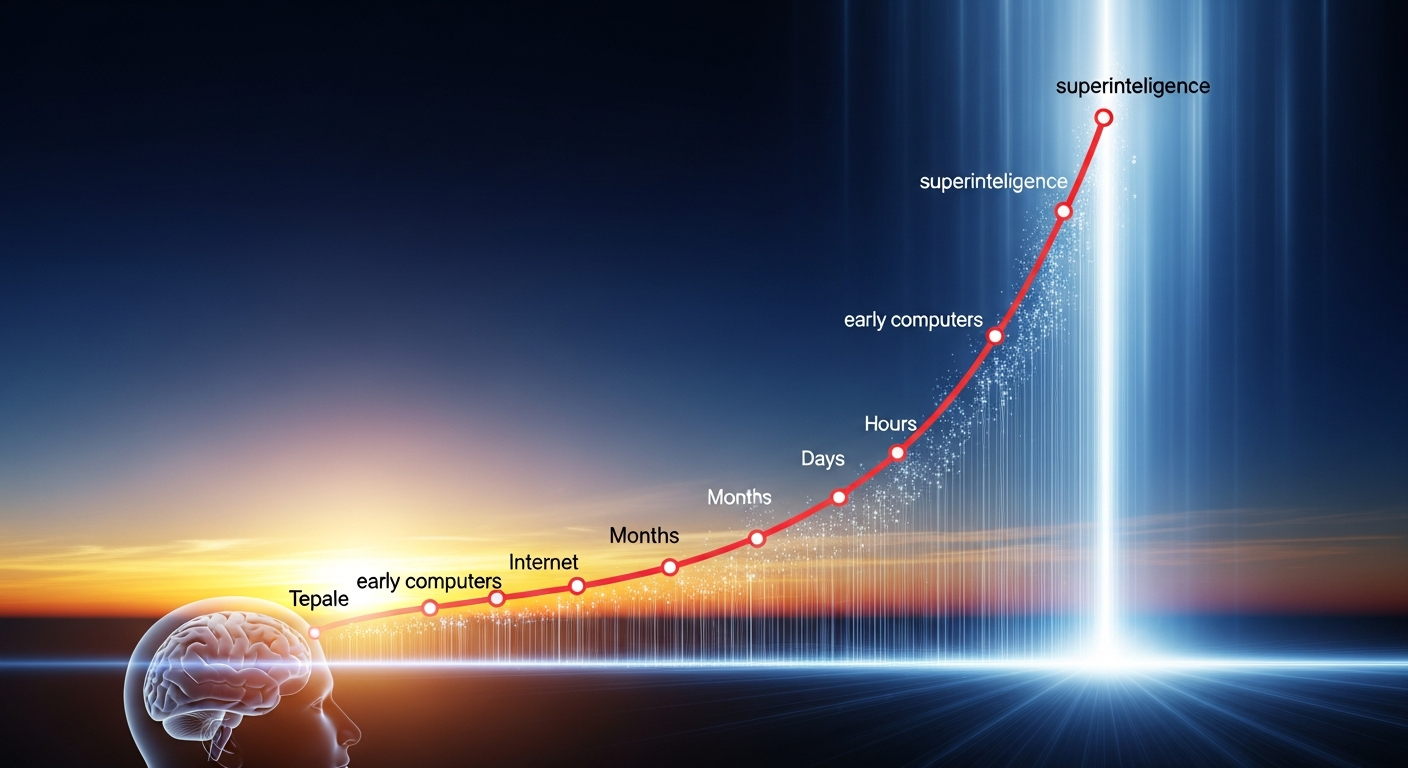
Ray Kurzweil popularized this concept and predicts the Singularity will occur around 2045. His reasoning: exponential trends in computing power, when extrapolated, suggest machine intelligence will surpass human intelligence within decades.
The Key Figures
FM-2030 (Fereidoun M. Esfandiary)
The Iranian-American futurist who coined much of transhumanist terminology and whose "Are You a Transhuman?" (1989) became a foundational text. He chose his name to symbolize his belief that he would live to see the year 2030. He didn't—he was cryopreserved in 2000.
Max More and Natasha Vita-More
The founders of the Extropy Institute (1988-2006), which formalized transhumanism as a coherent philosophy with explicit principles: boundless expansion, self-transformation, dynamic optimism, intelligent technology, and spontaneous order.
Nick Bostrom
Oxford philosopher who founded the Future of Humanity Institute and wrote Superintelligence (2014), which brought AI safety concerns into mainstream discourse. His work provides philosophical rigor to transhumanist speculation.
Aubrey de Grey
The controversial biogerontologist whose SENS Research Foundation pursues radical life extension. His approach: treat aging as a set of engineering problems to be solved, not as an inevitable aspect of the human condition.
Ray Kurzweil
Inventor, futurist, and Google's Director of Engineering. His books The Age of Spiritual Machines (1999) and The Singularity Is Near (2005) are definitive popular statements of the Singularity hypothesis. Famously takes 150+ supplement pills daily to "live long enough to live forever."
The Cosmic Vision
Transhumanists don't stop at individual enhancement. The Millennial Project (updated as Millennial Project 2.0) outlines humanity's expansion into the cosmos in eight phases:
- Foundation - Building the organizational and financial infrastructure
- Aquarius - Ocean-based renewable energy and floating cities
- Bifrost - Space elevators for cheap orbital access
- Asgard - Orbital habitats and space stations
- Avalon - Moon and Mars colonization
- Elysium - Terraforming Mars
- Solaria - Solar system civilization
- Galactica - Interstellar colonization

The Kardashev Scale provides a framework for measuring civilizational progress:
- Type I: Harnesses all energy available on its planet
- Type II: Harnesses all energy from its star (Dyson sphere)
- Type III: Harnesses all energy in its galaxy
Earth currently ranks at approximately 0.7 on this scale.
The Critiques
Transhumanism faces criticism from multiple directions:
Practical Impossibility
Many proposals (molecular assemblers, mind uploading, artificial superintelligence) remain unproven and may violate fundamental physical or computational limits we don't yet understand.
The Naturalistic Objection
Critics like Leon Kass argue there's wisdom in natural human limits. Death gives life meaning. Finitude drives achievement. Enhancement might destroy what makes us human.
Social Justice Concerns
If enhancement technologies are expensive, they could create unprecedented inequality—a genetic and cognitive underclass permanently subordinate to an enhanced elite.
The Frankenstein Accusation
Are transhumanists guilty of hubris? Of playing God? Of risking catastrophe by pushing beyond safe boundaries?
Religious Opposition
From both progressive and conservative religious perspectives, transhumanism can be seen as either blasphemous (attempting to be God) or as abandoning spiritual development for material enhancement.
The Current State
Transhumanism has moved from fringe to increasingly mainstream:
-
Zoltan Istvan ran for US President (2016, 2020) and California Governor on an explicitly transhumanist platform, campaigning from a coffin-shaped "Immortality Bus"
-
Singularity University (co-founded by Kurzweil and Peter Diamandis with NASA and Google support) trains executives and entrepreneurs in exponential technologies
-
SENS Research Foundation and similar organizations pursue legitimate research into aging
-
Neuralink (Elon Musk) and other companies develop brain-computer interfaces
-
CRISPR gene editing has made genetic enhancement technically feasible
-
Major tech companies invest billions in AI research, accelerating the timeline toward potential superintelligence
What This Means for Builders
Manzocco's book concludes with a nuanced assessment: "Everything is possible in this world, and the forecasts of the Transhumanists could actually occur according to the modalities and timing established by them. But also maybe not."
For technologists and builders, the key insights are:
1. Think in Longer Timeframes
Transhumanists operate on century-long timescales. Many of their predictions may be wrong in detail but right in direction. The question isn't "will this happen?" but "when, and in what form?"
2. Technology Is Not Neutral
The technologies emerging from transhumanist research—AI, biotechnology, brain-computer interfaces—will fundamentally reshape society. Builders have responsibility for the worlds their technologies create.
3. The Ethical Frameworks Matter
The debates happening now about AI safety, genetic enhancement ethics, and human augmentation will determine the trajectory of these technologies. Engaging with these debates is essential.
4. Individual Projects, Collective Vision
Each transhumanist project (de Grey's SENS, Kurzweil's AI predictions, etc.) stands or falls on its own merits. But together they form a coherent vision of possibility that's worth understanding.
5. The Amortals Are Already Here
As Manzocco notes, millions of people already live as "amortals"—refusing to accept aging, investing heavily in health and longevity, implicitly betting that science will solve death in their lifetime. This isn't fringe thinking anymore; it's becoming mainstream aspiration.
Conclusion
Transhumanism - Engineering the Human Condition is essential reading for anyone building the future. Whether you find the transhumanist vision inspiring or alarming, its core technologies—AI, biotechnology, nanotechnology, cognitive enhancement—are advancing regardless of philosophical debates.
The choice isn't whether these technologies will transform humanity. The choice is whether we'll guide that transformation thoughtfully or let it happen to us.
As Kurzweil puts it: "The fate of the Universe is a decision yet to be made, one which we will intelligently consider when the time is right."
The transhumanists are betting that time is now.
Based on: Manzocco, R. (2019). Transhumanism - Engineering the Human Condition: History, Philosophy and Current Status. Springer Praxis Books.
Further Reading:
- Superintelligence by Nick Bostrom
- The Singularity Is Near by Ray Kurzweil
- Ending Aging by Aubrey de Grey
- Engines of Creation by Eric Drexler
- The Transhumanist Reader edited by Max More and Natasha Vita-More
Written by
Global Builders Club
Global Builders Club
If you found this content valuable, consider donating with crypto.
Suggested Donation: $5-15
Donation Wallet:
0xEc8d88...6EBdF8Accepts:
Supported Chains:
Your support helps Global Builders Club continue creating valuable content and events for the community.