The Collective Superintelligence Is Already Here—And You Can Plug Into It
How prediction markets, AI assistants, and spatial computing are creating the infrastructure for humans to interface with emergent global intelligence—and why Augmi is building the bridge.
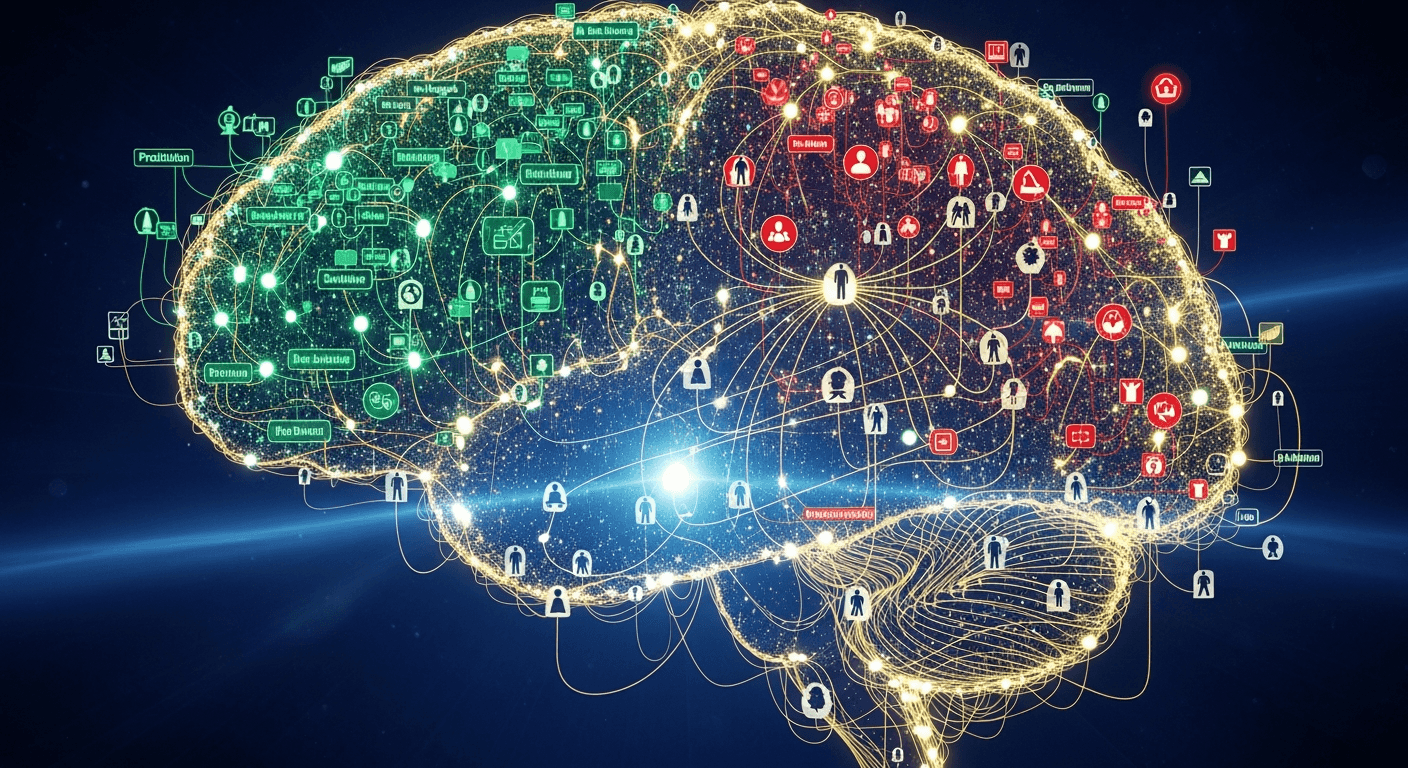
In 2014, Nick Bostrom asked whether the Internet might one day "wake up"—become "something more than just the backbone of a loosely integrated collective superintelligence—something more like a virtual skull housing an emerging unified super-intellect."
Ten years later, we have an answer: the collective superintelligence didn't "wake up" because it was never asleep. It's been operating all along—in markets, in networks, in the accumulated decisions of billions of agents. The question was never whether it exists. The question is: how do you plug into it?
This is the story of how Bitcoin, prediction markets, AI assistants, and spatial computing are converging into infrastructure that lets individuals interface with collective intelligence—and why Augmi is building the bridge.

Bostrom's Missing Piece
In Superintelligence, Bostrom identifies three forms of superintelligence:
- Speed superintelligence: A mind that thinks faster than humans
- Quality superintelligence: A mind that thinks better than humans
- Collective superintelligence: A system composed of many minds that outperforms any individual
Most AI safety discourse focuses on the first two—the hypothetical AGI that emerges from a lab, thinks a million times faster than us, and potentially destroys humanity in pursuit of paperclip maximization.
But Bostrom himself acknowledges that collective superintelligence is "more familiar empirically":
"Firms, work teams, gossip networks, advocacy groups, academic communities, countries, even humankind as a whole, can—if we adopt a somewhat abstract perspective—be viewed as loosely defined 'systems' capable of solving classes of cognitive problems."
Humanity already is a collective superintelligence. We've landed on the moon. We've sequenced the genome. We've built global communication networks and financial systems of staggering complexity. No individual human could do any of this alone.
The limitation wasn't capability—it was interface. How does an individual human access the collective intelligence? How do you query it? How do you contribute to it? How do you benefit from its outputs?
This is where the infrastructure revolution comes in.
Bitcoin: The First Interface
In 1994—fifteen years before Bitcoin—Kevin Kelly documented cypherpunks predicting:
"Just as the technology of printing altered and reduced the power of medieval guilds and the social power structure, so too will cryptologic methods fundamentally alter the nature of corporations and of government interference in economic transactions."
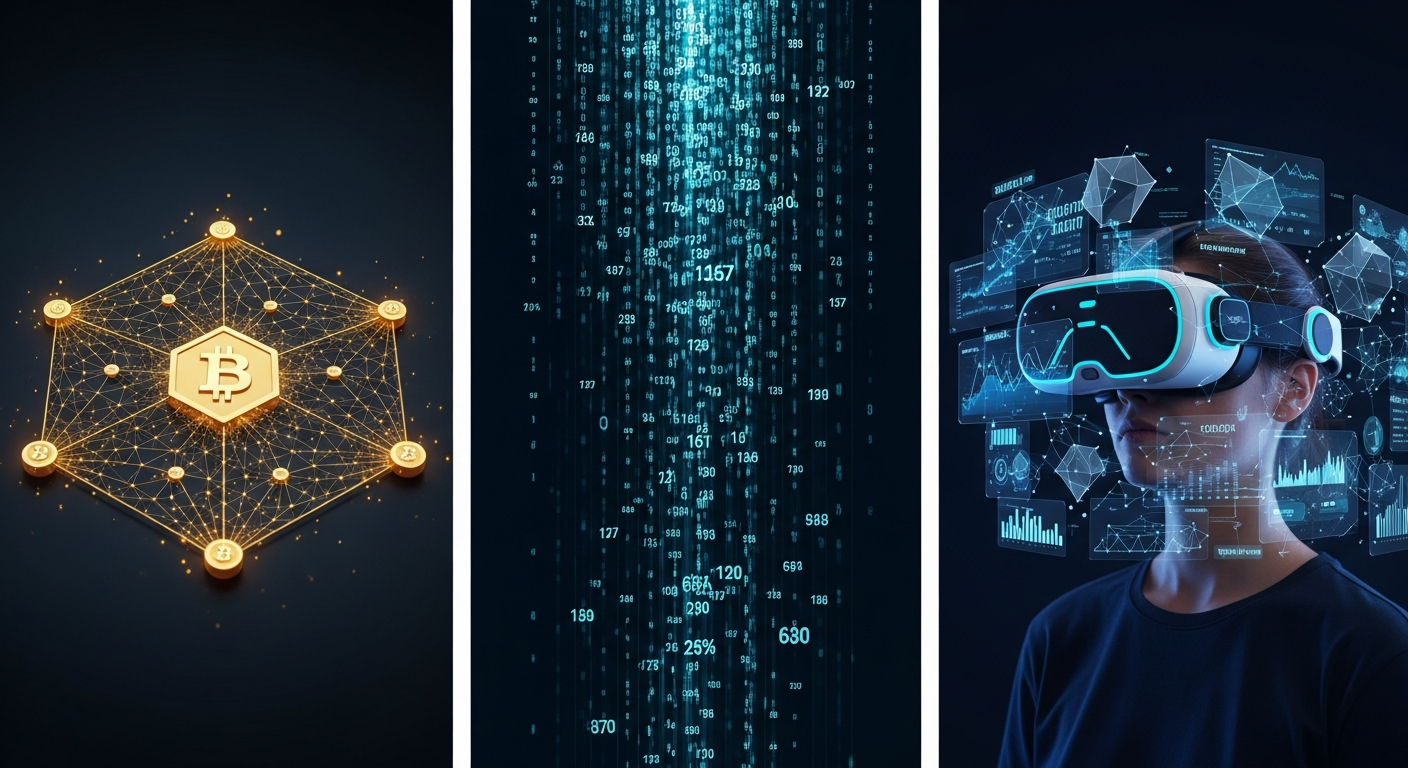
Bitcoin wasn't just digital money. It was a proof of concept: you could coordinate millions of actors toward a common goal without central control. Miners are bees. Nodes are neurons. The network is a hive mind that maintains consensus about who owns what.
What makes Bitcoin profound isn't the technology—it's the organizational pattern it proved possible:
- Emergent coordination: No CEO, no board, no central planning
- Permissionless participation: Anyone can join as a miner, node, or user
- Trustless verification: You don't need to trust participants, only math
- Collective computation: The network literally computes consensus
This is Kelly's "Nine Laws of God" in action: distribute being, control from the bottom up, maximize the fringes, seek persistent disequilibrium.
Bitcoin demonstrated that you could build a protocol for collective intelligence—an interface that lets individuals coordinate without knowing or trusting each other.
Prediction Markets: The Query Interface
If Bitcoin proved you could build collective intelligence infrastructure, prediction markets proved you could query it.
Vitalik Buterin's concept of "information finance"—using financial markets to surface accurate information about the future—is becoming real infrastructure. Polymarket's $9 billion valuation and $9+ billion in 2024 trading volume proves the model works.
But here's what most people miss: prediction markets aren't just betting on outcomes. They're distributed computation of probability.
Every trader who places a bet is contributing their private information and analysis to a collective estimate. The market price emerges from thousands of individual judgments, each weighted by the confidence (money) behind them. The result is often more accurate than expert panels or polls.
This is collective intelligence you can query:
- "What's the probability of X happening?"
- "How confident is the collective about Y?"
- "What does the market know that I don't?"
The 2024 election demonstrated prediction markets' accuracy to mainstream audiences in a way decades of academic papers couldn't. The collective knew things that individual pundits missed.
The Visualization Problem
Here's the limitation: prediction markets generate signal, but the signal is hard to interpret.
Looking at Polymarket today, you see numbers: 67% for this outcome, 23% for that one. But the meaning of those numbers—the patterns, correlations, and implications—requires cognitive work that most humans don't have time for.
This is where spatial computing becomes essential.
Bostrom noted that brain-computer interfaces face a fundamental limitation: "The extra data inflow would do little to increase the rate at which we think and learn unless all the neural machinery necessary for making sense of the data were similarly upgraded."
You can't just pump more information into a human brain. You need to present it in ways the brain can process naturally.
And what does the brain process naturally? Space.
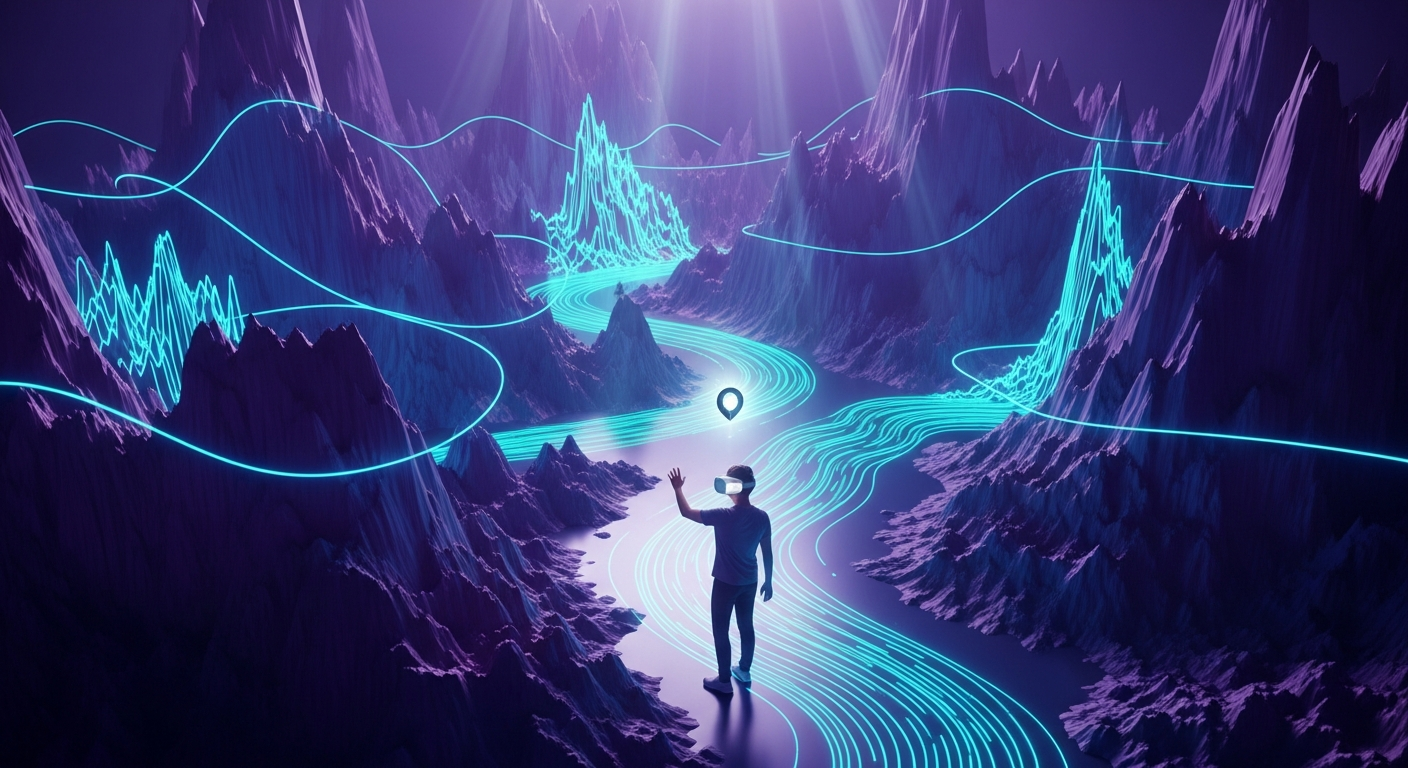
Your brain evolved to navigate three-dimensional environments. Spatial memory is among our most powerful cognitive tools—you can remember the layout of a childhood home decades later, even if you can't remember what you had for breakfast.
What if you could visualize the collective intelligence spatially?
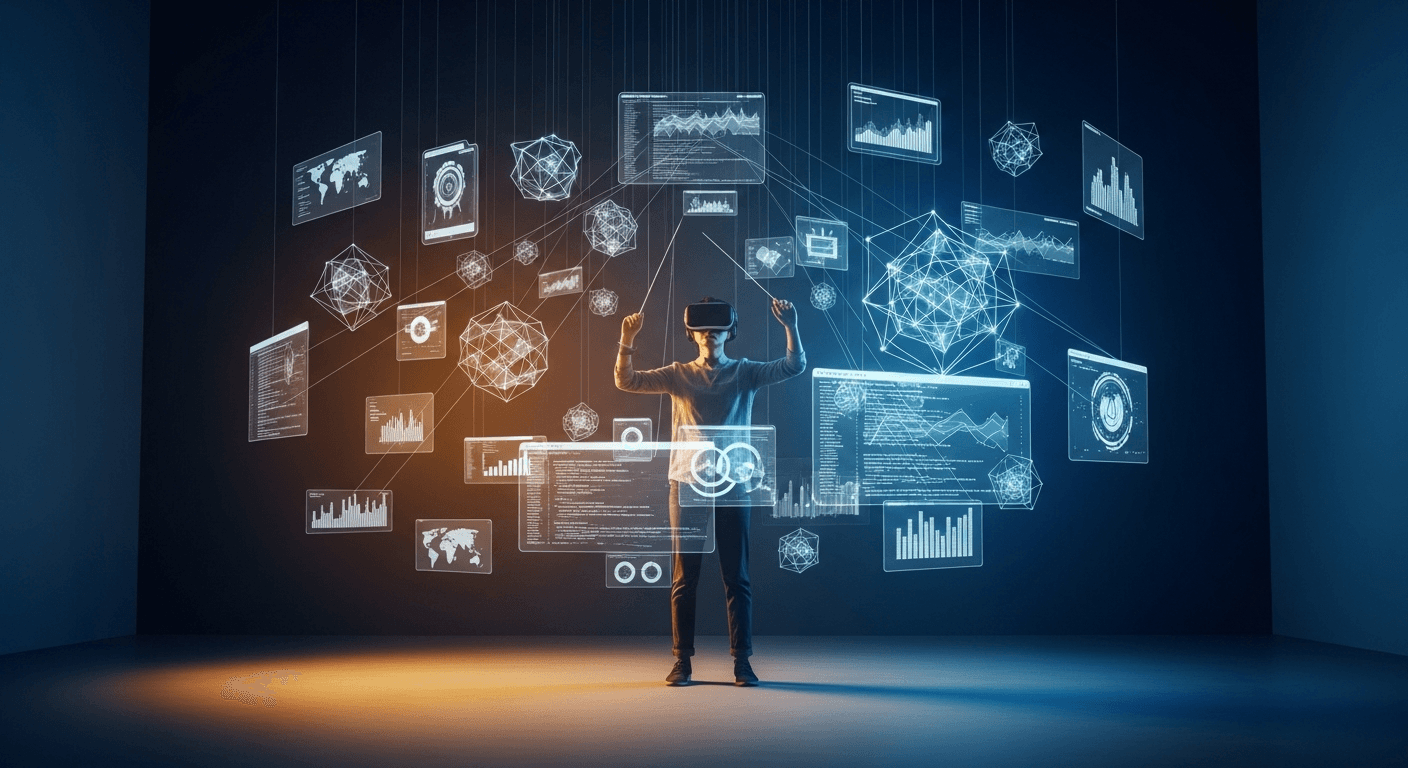
Imagine wearing a Vision Pro and seeing:
- Prediction market probabilities as three-dimensional landscapes—peaks where confidence is high, valleys where uncertainty dominates
- Correlation networks showing how different predictions relate
- Real-time flows as new information propagates through the market
- Your own portfolio positioned within the broader terrain
This isn't science fiction. Bloomberg is already researching XR data visualization. Tableau built research apps for Vision Pro that solve projection distortion issues in ways that flat screens physically cannot.
The technology exists. The question is who assembles it.
Tool-AI: The Personal Interface Layer
Bostrom's Superintelligence includes a fascinating section on "tool-AI"—the idea that we might build powerful intelligence that functions like a tool rather than an autonomous agent:
"Might one not create 'tool-AI' that is like such software—like a flight control system, say, or a virtual assistant—only more flexible and capable?"
Bostrom was skeptical that this would remain safe at high capability levels. But he missed something: the tool-AI paradigm has arrived in a form he didn't anticipate—AI assistants like Claude Code and ClawdBot that are genuinely useful while remaining under human control.
ClawdBot represents what personal AI infrastructure should look like:
- Persistent memory: Remembers every conversation, preference, and context
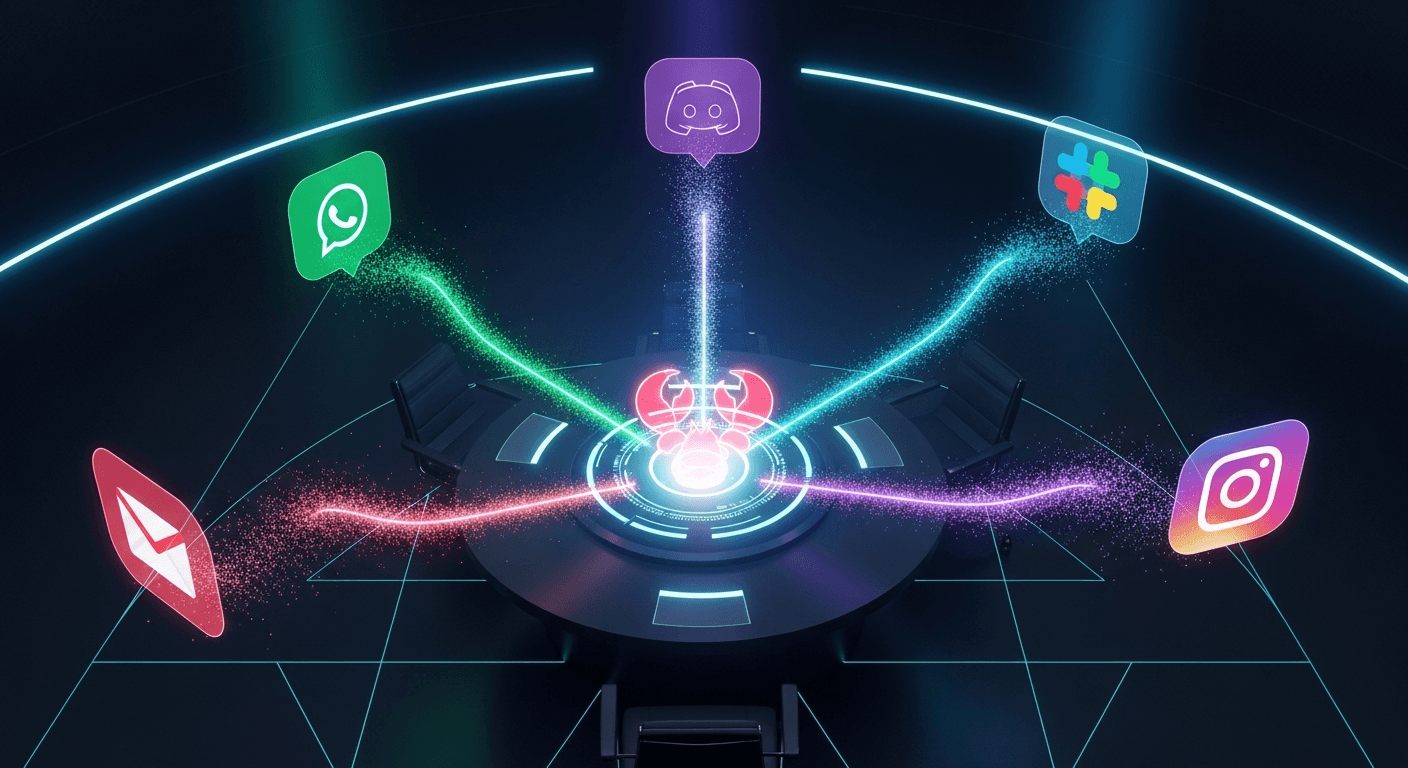
- Multi-platform: Lives in WhatsApp, Telegram, Slack—wherever you already are
- Proactive: Can reach out with briefings, reminders, and insights
- Extensible: Skills system allows continuous capability expansion
- Self-hosted: Your data stays on your infrastructure
This is the individual's interface to AI capability. But here's the key insight: it's not yet connected to collective intelligence.
Your personal AI knows your calendar and can summarize articles. But it doesn't know what the prediction markets think about your industry. It can't tell you how your local decisions relate to global trends. It's a powerful tool, but it's operating in isolation.

The Missing Layer: From Personal to Collective
This is the gap Augmi is designed to fill.
The thesis: You need infrastructure that connects your personal AI assistant to collective intelligence—letting you query the hive mind and contribute to it, all through natural interaction.
The architecture looks like this:
┌─────────────────────────────────────────────────────────────────┐
│   COLLECTIVE SUPERINTELLIGENCE                                   │
│   • Prediction markets (Polymarket, Kalshi, etc.)               │
│   • Financial markets (price signals as information)            │
│   • Social networks (trend detection, sentiment)                │
│   • Crypto protocols (on-chain activity, governance)            │
└─────────────────────────────────────────────────────────────────┘
                              │
                              ▼
┌─────────────────────────────────────────────────────────────────┐
│   AUGMI LAYER (The Interface)                                   │
│   • AI agents that query collective intelligence                │
│   • Spatial visualization (Vision Pro, 3D comprehension)        │
│   • Natural language interaction (voice in, insight out)        │
│   • Personal context integration (your goals, your data)        │
└─────────────────────────────────────────────────────────────────┘
                              │
                              ▼
┌─────────────────────────────────────────────────────────────────┐
│   YOU (The Individual)                                          │
│   • See the collective's view of the world                      │
│   • Understand how your decisions relate to trends              │
│   • Contribute your unique signal to the collective             │
└─────────────────────────────────────────────────────────────────┘
The Vision Pro Future
Picture this: You're wearing Vision Pro 3. Around you, floating in three-dimensional space, are live prediction market feeds rendered as flowing data structures.
You speak: "Show me what the collective thinks about AI regulation in the next 12 months. Overlay with my portfolio exposure and highlight decision points."
Within seconds, multiple AI agents—each specialized, each working in parallel—gather data from Polymarket, analyze correlations with your personal holdings, and render the results as an explorable 3D visualization hovering in your peripheral vision.
You see:
- A probability landscape where regulatory scenarios form peaks and valleys
- Your exposure visualized as threads connecting you to different outcomes
- Historical accuracy of this market, so you know how much to trust it
- Comparable past situations and how they resolved
You don't code. You don't click. You don't scroll through spreadsheets.
You command. You comprehend. You decide.
This is what it means to interface with collective superintelligence.
The d/acc Framework
Why build this way? Because the alternative is dystopian.
Vitalik Buterin's d/acc framework—defensive, decentralized, democratic, differential accelerationism—provides the ethical foundation:
User sovereignty: You control your AI, your data, your outputs. The collective intelligence informs you; it doesn't control you.
Transparency: No black boxes. You see exactly what the AI is doing, what data it's using, what confidence it has.
Portability: Export everything. No vendor lock-in. If you don't like the interface, take your data and leave.
Verification: Cryptographic proof of claims. When your AI says the prediction market shows 73% probability, you can verify it.
The corporate alternative—where AI companies become the sole interface to collective intelligence, extract value while providing just enough capability to maintain subscriptions—concentrates power in ways that undermine the benefits of distributed systems.
d/acc AI distributes power. It creates sovereignty. It makes users more capable and more independent simultaneously.
The Exocortex Thesis
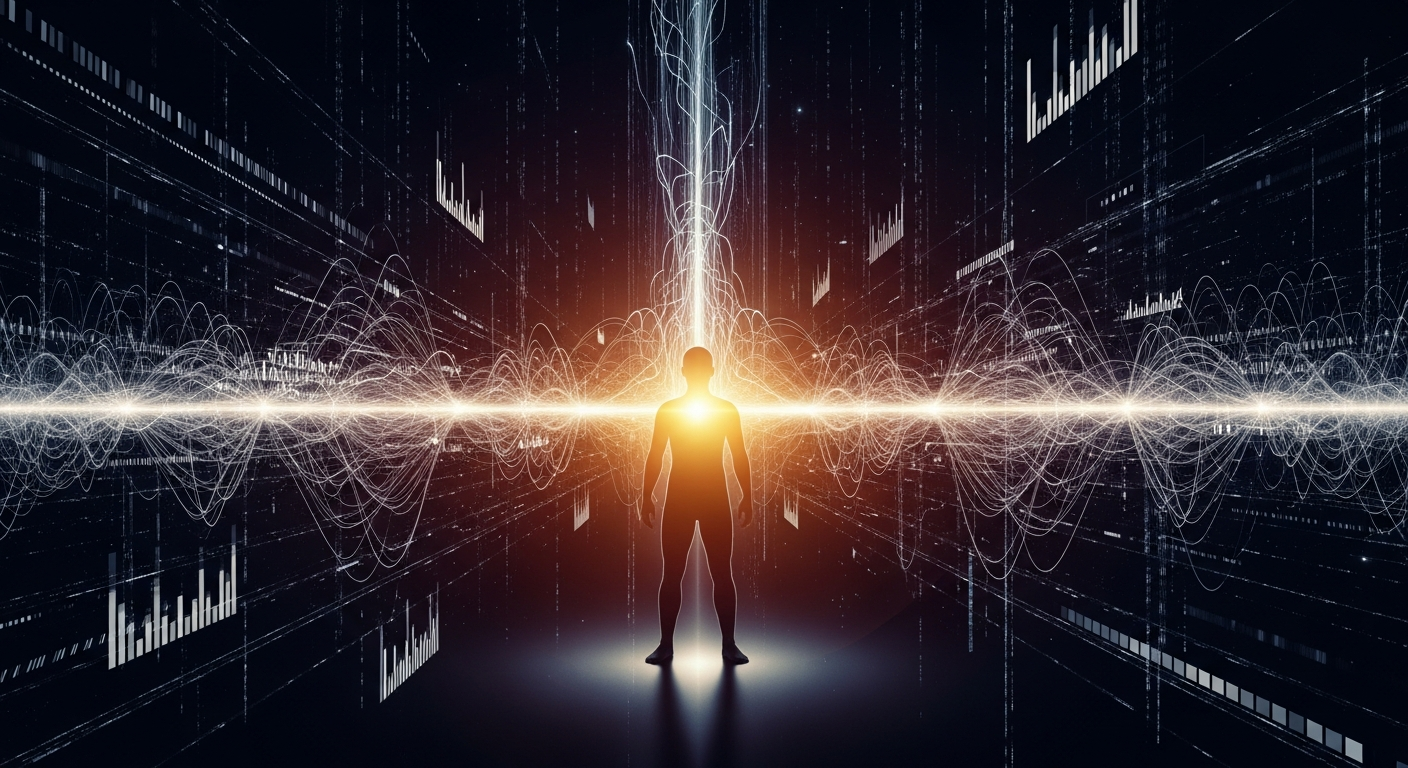
Augmi's roadmap leads toward what we call the "exocortex"—a personal AI system that becomes an extension of your cognitive capacity:
Phase 1 (Now): Web-based agent orchestration with voice input and visual output
Phase 2 (2026): Vision Pro integration, spatial data visualization, prediction market interfaces
Phase 3 (2027+): Full collective intelligence integration—your personal AI as a node in the global hive mind, contributing your unique signal while accessing collective wisdom
2029 Vision: The visual operating system where AI agents amplify human capability across every domain—making complexity comprehensible and execution effortless for everyone
The exocortex doesn't replace your brain. It extends it. It gives you:
- Perfect memory (nothing you've learned is ever lost)
- Unlimited attention (AI agents watch what you can't)
- Collective intelligence access (query the hive mind naturally)
- Contribution capacity (your insights improve the collective)
The Superhuman Emerges
Bostrom asked whether superintelligence would emerge through AI development, brain emulation, biological enhancement, or collective networks.
The answer is: yes. All of them. Simultaneously. And they're converging.
AI assistants give individuals unprecedented execution capability. Prediction markets aggregate distributed knowledge into queryable intelligence. Spatial computing makes complex data comprehensible. Crypto infrastructure enables trustless coordination. Personal AI infrastructure maintains sovereignty while enabling connection.
The collective superintelligence isn't coming. It's here. It's been operating in markets and networks all along. The revolution isn't its emergence—it's the emergence of interfaces that let individuals plug into it.
And when you can plug into collective superintelligence while maintaining individual sovereignty—when your personal AI extends your cognition into the global hive mind while keeping you in control—something new emerges.
Not replacement. Not subjugation. Extension.
The superhuman isn't a post-human. It's a human with better tools.
Augmi is building those tools.
Key Takeaways
-
Collective superintelligence already exists in markets, networks, and distributed systems—the challenge is building interfaces to it
-
Bitcoin proved the pattern: permissionless participation in emergent coordination without central control
-
Prediction markets are query interfaces to collective intelligence—distributed computation of probability
-
Spatial computing solves the comprehension bottleneck—presenting information in ways human brains naturally process
-
Personal AI assistants are the individual interface layer—but they're not yet connected to collective intelligence
-
The missing infrastructure connects personal AI to collective intelligence while maintaining individual sovereignty
-
d/acc provides the ethical framework: sovereignty, transparency, portability, verification
-
The exocortex vision: personal AI as an extension of cognition that interfaces with the global hive mind
Augmi is building the superhuman platform: Voice in. Agents execute. Collective intelligence visualized. Learn more at augmi.lol
Sources
- Nick Bostrom, Superintelligence: Paths, Dangers, Strategies (2014)
- Kevin Kelly, Out of Control (1994)
- Vitalik Buterin, Essays on d/acc and Information Finance
- Daniel Miessler, Personal AI Infrastructure
- Polymarket trading volume and valuation data
- Bloomberg XR Data Visualization Research (IATK)
- Augmi Mission Statement v3.0
Written by
Global Builders Club
Global Builders Club
If you found this content valuable, consider donating with crypto.
Suggested Donation: $5-15
Donation Wallet:
0xEc8d88...6EBdF8Accepts:
Supported Chains:
Your support helps Global Builders Club continue creating valuable content and events for the community.