The DAO Trap: Why Your Crypto Investment Could Cost You Everything You Own
The courts have spoken. Decentralization doesn't mean immunity. Recent rulings found DAO token holders personally liable for organizational debts. Here's what you need to know.
The DAO Trap: Why Your Crypto Investment Could Cost You Everything You Own
The courts have spoken. Decentralization doesn't mean immunity. And that governance token in your wallet might be a ticking time bomb.
The promise was intoxicating: organizations governed by code, not corruptible executives. Treasuries controlled by the community, not greedy boards. A new form of coordination that would make traditional corporations obsolete.
What nobody mentioned was the personal liability.

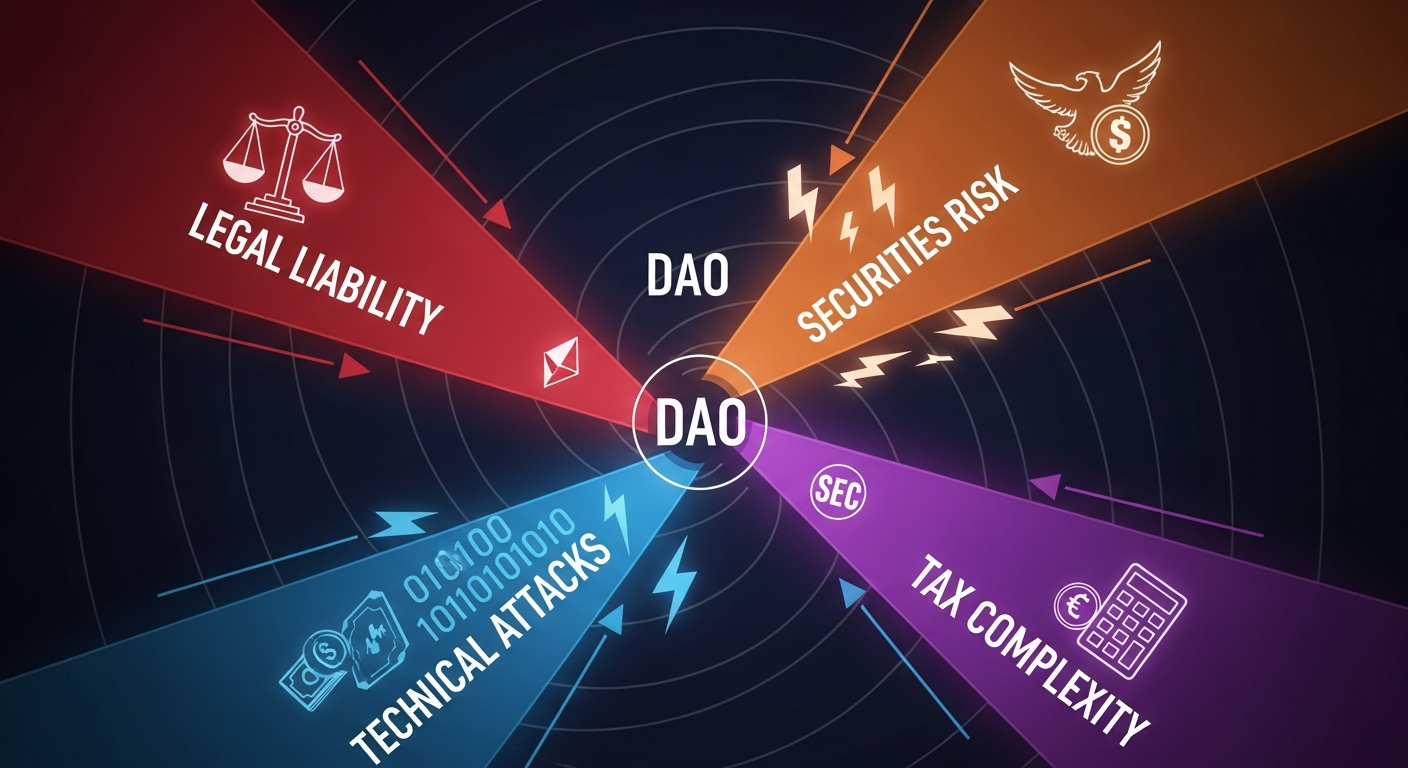
In the last two years, a series of landmark court rulings have systematically dismantled the legal fiction that DAOs exist in some regulatory grey zone. The Samuels v. Lido DAO case found that one of crypto's largest DAOs meets California's definition of a general partnership—meaning every token holder, including venture capital giants like Paradigm and Andreessen Horowitz, could be held personally liable for the organization's debts and legal violations.
Not liability capped at their investment. Unlimited personal liability. Houses, savings accounts, everything.
If you've created a DAO on platforms like DAOhaus, Aragon, or Snapshot without establishing a proper legal wrapper, or if you hold governance tokens for any major protocol, this analysis is your wake-up call.
The General Partnership Trap
When courts encounter an organization that doesn't fit neatly into existing categories, they don't scratch their heads and give up. They apply default rules. And the default rule for two or more people associating to carry on a business for profit is the oldest structure in commercial law: the general partnership.
In a general partnership, every partner is personally liable for all the partnership's obligations. Not proportionally. Not capped at their contribution. Everything.
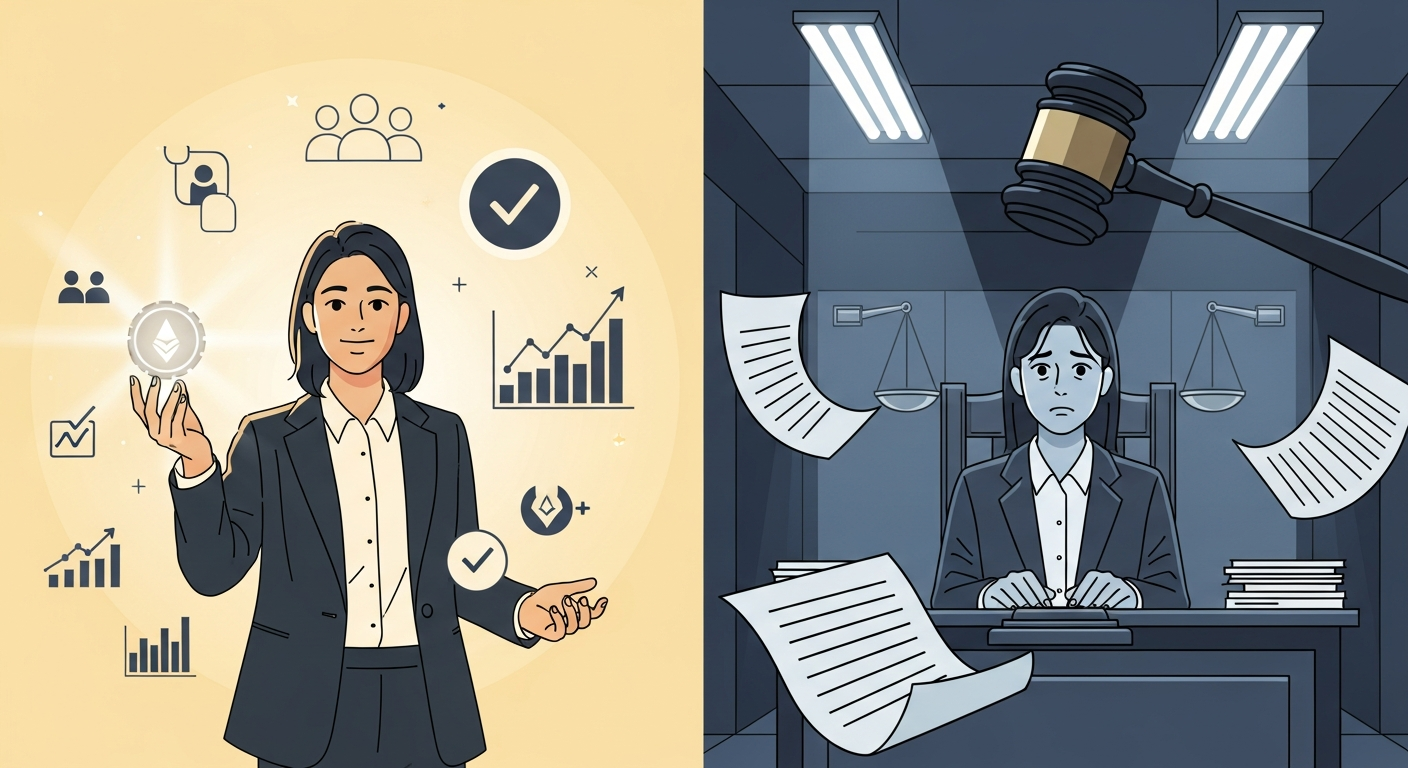
The Samuels v. Lido DAO ruling made this explicit. The Northern District of California found that Lido DAO's founders and token holders were "actively involved in governance"—enough to establish partnership. The court explicitly rejected the argument that Lido was "merely autonomous software."
"The founders of Lido DAO formed it as a business for profit," the court wrote, "and no explicit partnership agreement was required."
The CFTC v. Ooki DAO case went further. The Commodity Futures Trading Commission obtained a default judgment finding that Ooki DAO was an "unincorporated association" that could be sued, that DAOs are "persons" under federal law, and—critically—that legal documents can be served through the DAO's online forum.
There is no escape from jurisdiction simply by existing only on-chain. If your DAO has a Discord, a governance forum, or even a Twitter account, regulators can find you.
The Flash Loan Nightmare
Legal liability isn't even the scariest part. The technical attack vectors are worse.
In April 2022, the Beanstalk protocol lost $181 million in a flash loan governance attack that took approximately 12 seconds. Here's how it worked:
- The attacker borrowed massive amounts of governance tokens through a flash loan (no collateral required, repayment due within same transaction)
- With the borrowed tokens, they gained 79% voting power
- They submitted and passed a malicious proposal granting themselves treasury access
- They drained the treasury
- They repaid the flash loan
- All within a single Ethereum block
Traditional governance defenses assume humans have time to respond. Flash loan attacks assume they don't. By the time anyone realized what happened, it was over.
This isn't ancient history. In April 2025, GreenField DAO lost $31 million to the same attack pattern.
The Securities Time Bomb
If the partnership liability and flash loan attacks weren't enough, there's also the securities problem.
The SEC's 2017 DAO Report established that governance tokens generally qualify as securities under the Howey Test if they involve:
- Investment of money (buying tokens: check)
- In a common enterprise (the DAO: check)
- With expectation of profits (token appreciation: check)
- Derived from efforts of others (developers, governance: check)
Most governance tokens satisfy all four criteria.
The implications are severe. Selling tokens could constitute selling unregistered securities—a federal crime. Every token holder who participated in governance could be considered an "issuer." The penalties include civil fines, cease-and-desist orders, and criminal prosecution.
As one attorney warned in Cointelegraph: "You can now have 1,000 governance tokenholders that are involved in a potential breach of securities laws—securities regulators can theoretically go after every single one."
The Platform Illusion
Here's what platforms like DAOhaus, Aragon, and Snapshot don't tell you: using their tools doesn't create a legal entity. It doesn't limit your liability. It doesn't shield you from regulators.
These platforms provide governance infrastructure—voting systems, treasury management, proposal tools. What they don't provide is the one thing that actually matters: a legal structure that protects participants from unlimited personal liability.
When you launch a DAO on DAOhaus, you're not incorporating a company. You're creating a general partnership with every person who buys a governance token. The platform makes this easy. It doesn't make it safe.
The Solutions (Yes, They Exist)
The situation isn't hopeless. Legal frameworks for DAOs have evolved significantly, particularly in the last two years.
Wyoming DAO LLC: In 2021, Wyoming became the first U.S. state to recognize DAOs as legal entities. The 2024 Decentralized Unincorporated Nonprofit Association Act (DUNA) expanded options further. These structures provide limited liability protection while preserving decentralized governance.
Marshall Islands: The Marshall Islands offers DAO LLC registration with minimal operational requirements and strong liability protection, making it popular for international projects.
The Harmony Framework: Introduced in February 2025, this "jurisdiction-neutral, modular" approach uses a DAO-Specific Entity (DSE) as a base layer with operational wrappers for specific activities—attempting to balance decentralization with legal recognition.
Insurance Products: Fenwick developed REBA, specialized insurance coverage for DAO participants similar to directors and officers policies. The market is underdeveloped but growing.
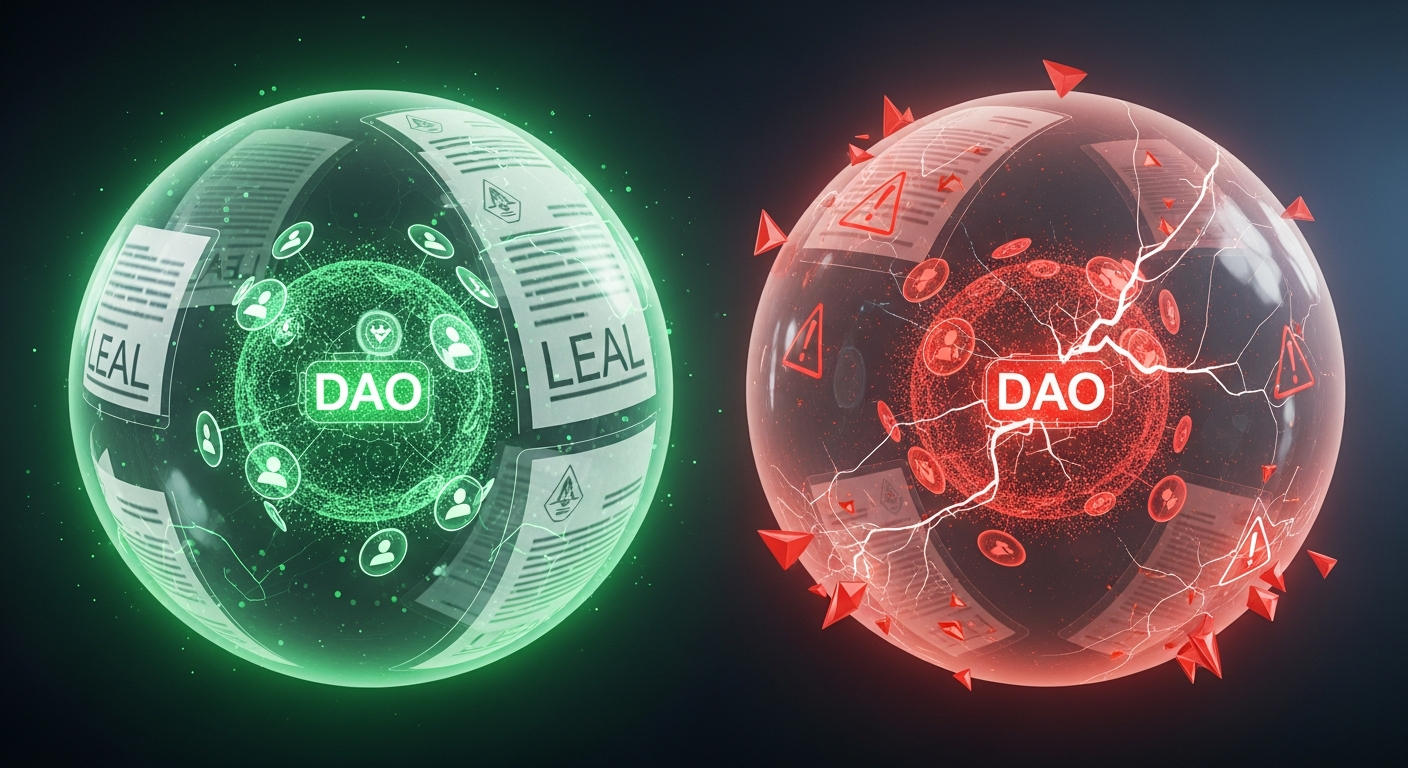
The catch: these protections must be established before launching tokens or accepting significant investment. Retroactively wrapping an existing DAO is complex, expensive, and may not provide complete protection for past activities.
The Uncomfortable Truth
The crypto ethos celebrates "code is law"—the idea that smart contract logic is the final arbiter of what's allowed. Avraham Eisenberg tested this theory when he extracted $110 million from Mango Markets by exploiting smart contract mechanics. He claimed it was legal because he followed the code's rules.
U.S. authorities arrested him.
Courts don't care about crypto-libertarian philosophy. They see people organizing to make money, and they apply centuries-old commercial law. The judges in Lido, Ooki, and bZx cases weren't confused by blockchain technology. They understood exactly what they were looking at: partnerships trying to avoid partnership liability by calling themselves something else.
The rulings are clear. The precedents are set. The risks are documented.
Creating or investing in a DAO without legal structure isn't bold or innovative. It's betting your personal assets—everything you own—on the hope that no one will sue, no regulator will notice, no attacker will strike, and no court will apply the default rules that have governed commercial associations for centuries.
The question isn't whether DAOs face legal consequences. It's whether you'll be the next example.
Takeaways
- Check your exposure: If you hold governance tokens, understand that you may have personal liability exposure
- Verify legal structure: Before investing in any DAO, confirm it has a proper legal wrapper (Wyoming DAO LLC, Marshall Islands, etc.)
- Understand governance security: Ask about time locks, snapshot voting, and flash loan protections
- Consider holding structure: Holding tokens through an LLC may provide some protection
- Don't assume decentralization = immunity: Courts have explicitly rejected this argument multiple times
The dream of trustless, decentralized organizations isn't dead. But it requires taking legal reality as seriously as cryptographic security. The code may be immutable. Personal liability isn't.
Have questions about DAO legal structures? Join the conversation in our community.
Written by
Global Builders Club
Global Builders Club
If you found this content valuable, consider donating with crypto.
Suggested Donation: $5-15
Donation Wallet:
0xEc8d88...6EBdF8Accepts:
Supported Chains:
Your support helps Global Builders Club continue creating valuable content and events for the community.